Content
- Principles of biosignals propagation
- Acquisition
- The recording chain
- Biosignals processing
Concepts and intuitions.
Lecturer in Psychophysiology and Cognitive Neuroscience
School of Psychology and Sport Science, Bangor University, UK
profile | research | software | learning resources | book meeting
On a computer press F11 to de/activate full-screen view.
For smartphone and review: Bottom left menu -> Tools -> PDF Export Mode.
For pdf document: use “learning resources” link above.
Last modified: 2026-02-16
QR code to
these slides:
By the end of this session, you should be able to elaborate on:
Approach:
Concepts and intuitions.
[Biosignals] are complex ramifications of the [electrochemical] spread of action [and graded] potentials in a conductive medium, the human body.
– Adapted from Stern et al. 2001
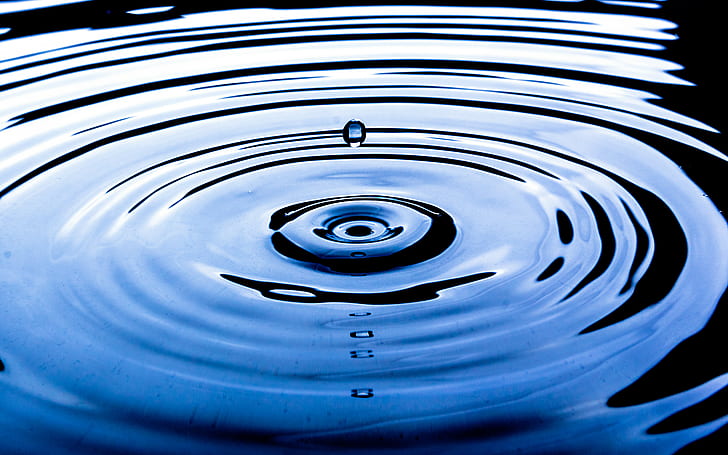
| ANALOGY | MEANING |
|---|---|
| stone | electrochemical event |
| water | medium for propagation |
| ripple | electrical field |
We will discuss the following principles of biosignals propagation:
Overarching objective:
Measure the electrical field associated with the biological event (the signal)
While discarding as much as possible of other, biological or not, events (the noise)
maximize signal to noise ratio:
\[ SNR = \frac{S}{N} \]
Signal to Noise Ratio (SNR) is a measure of how much the signal stands out from the noise. The higher the SNR, the better the quality of the recording.
The recording chain consists of the following stages:
Conductive material
Used in pairs to measure a difference in voltage. Note: One electrode alone cannot measure anything
At the interface between electrode and skin, electro-chemical reactions occur consisting of exchange of ions.
The exchange of ion generates an unwanted voltage, called offset potential (or bias potential).
The offset potential is a source of noise that can interfere with the signal. It can be reduced by using certain types of electrodes and by preparing the skin properly.
Desirable property of electrodes: stability against offset potential
Factors affecting electrode stability:
Lykken (1959) experimented with different metals.
Left pairs of electrode of various metals in a saline solution (electrolyte) for 1 hour.
Among several metals such as platinum, zinc, silver, silver / silver chloride (Ag/AgCl) showed the lowest offset potential. To this day, mostly electrodes are made of this metal.
Desirable property of skin-electrode interface low impedance, so the signal passes through with little resistance.
skin –> electrolytic gel –> electrode
Skin preparation to lower impedance:
Impedance matters more for smaller signals (e.g., EEG) because they are more affected by noise. For larger signals (e.g., ECG), impedance matters less because the signal is stronger and can stand out from the noise even with higher impedance.
While biological events have electrical nature, certain electrical fields are difficult to detect. Non-electrical consequences of these events are easier to detect.
Transducers convert (transduce) non-electrical signals to electrical signals (for the next steps of the recording chain)
For example, changes in blood volume or pupil diameter are easier to detect than the electrical field generated by the underlying electro-chemical event.
Photo-conductive transducer:
A common application: photoplethysmography (PPG) applied to the finger or earlobe, and used to measure heart rate (HR) and heart rate variability (HRV) by detecting the changes in blood volume that occur with each heartbeat.
Photo-sensitive transducer:
A common application: pupillometry, which is the measurement of pupil diameter. Changes in pupil diameter can be indicative of cognitive and emotional processes, as well as arousal levels.
Modern signal conditioners carry out multiple functions. The two main functions are:
Historical note: Older systems used a separate “coupler” component between sensors and signal conditioner. Modern systems integrate these functions directly into the signal conditioner.
Let’s first see waveforms of different frequencies.
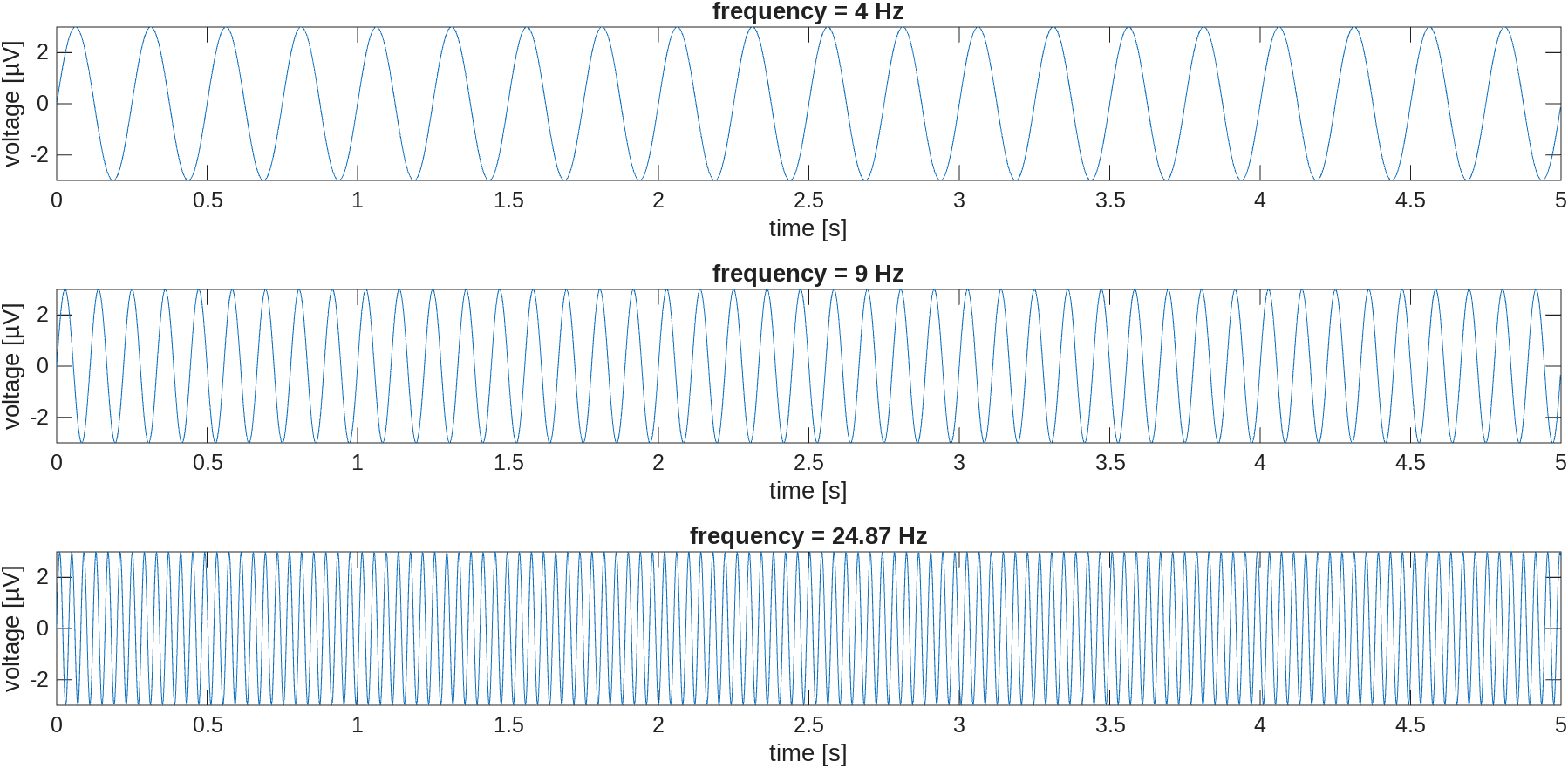
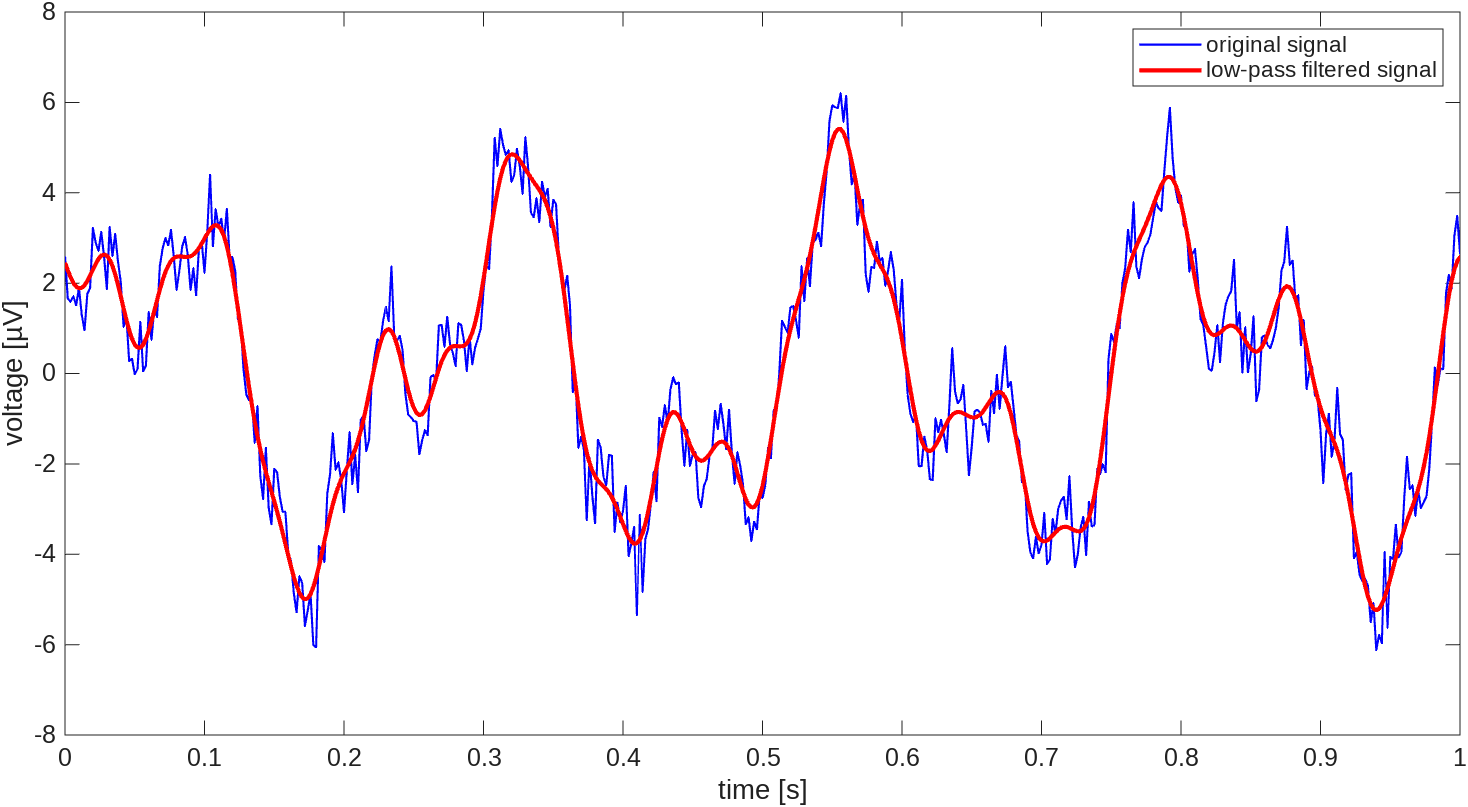
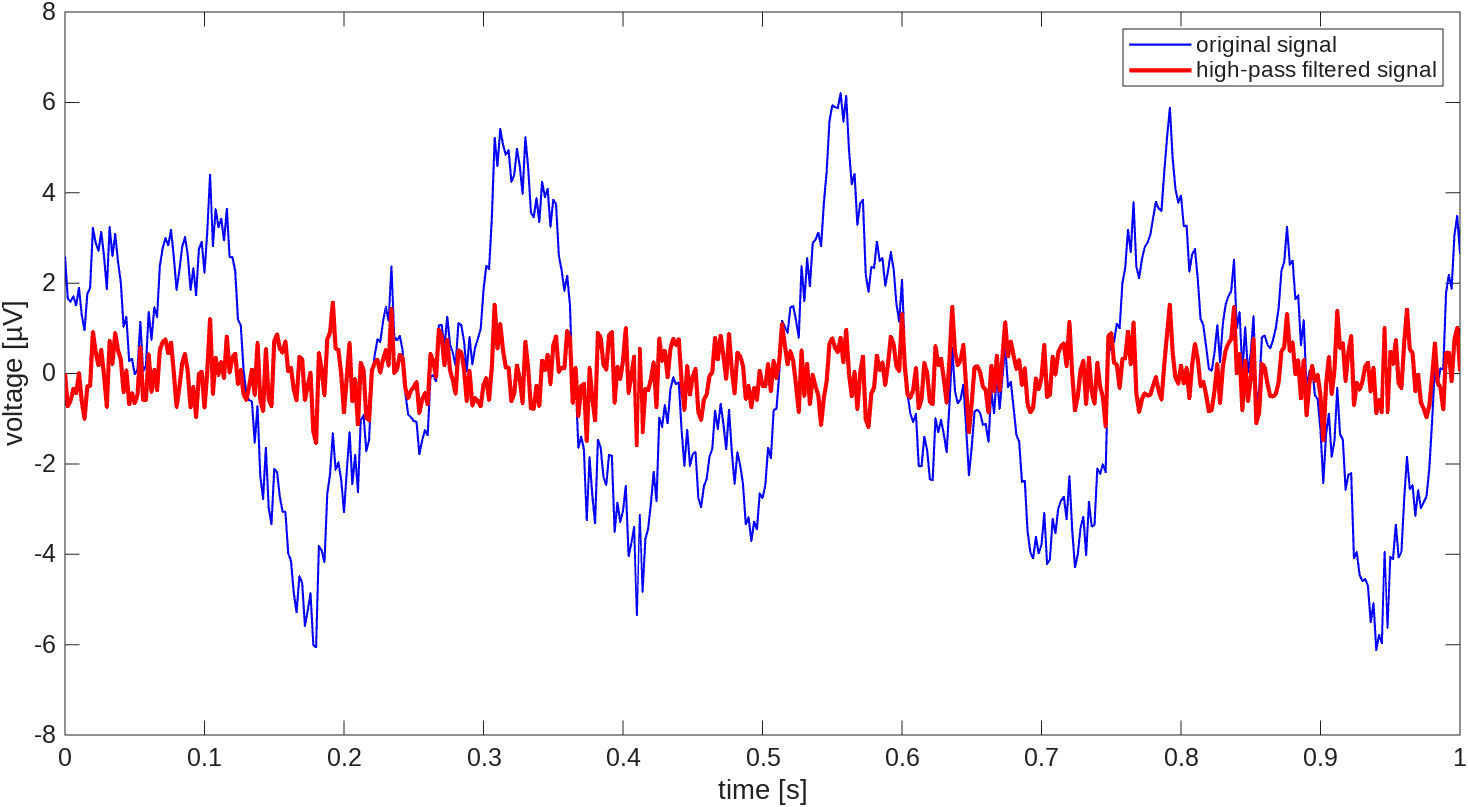
Filtering is the process of removing unwanted frequencies from the signal. Basic filter types:
Filters out fast (high) frequencies and therefore retains slow (low) frequencies
Filters out slow (low) frequencies and therefore retains fast (high) frequencies
A combination of high-pass and low-pass filters to allow frequencies between two cut-off values, which describe a frequency band. Frequencies outside of this band are filtered out.
Filters out only one frequency (and those immediately near it). Just like a very narrow band-stop filter.
Used to minimize the electrical interference from mains electricity (alternating current). In the UK, it is 50 Hz.
Filters require:
Depending on the sharpness parameter, frequencies near the transition are partly retained
In theory, a filter with a sharp transition is better. In practice, too sharp will create distortions.
Signals of interest are often very small in magnitude (e.g., microvolts for EEG) and can be easily obscured by noise. Amplification is used to increase the magnitude of the signal to make it more distinguishable from noise.
The multiplication factor by which the signal is amplified is called gain.
Traditionally, the signal is amplified so its magnitude reaches approximately 1 V.
For example, a signal with magnitude 1 mV will be multiplied by 1000 to reach 1 V. (In this example, the gain is 1000.)
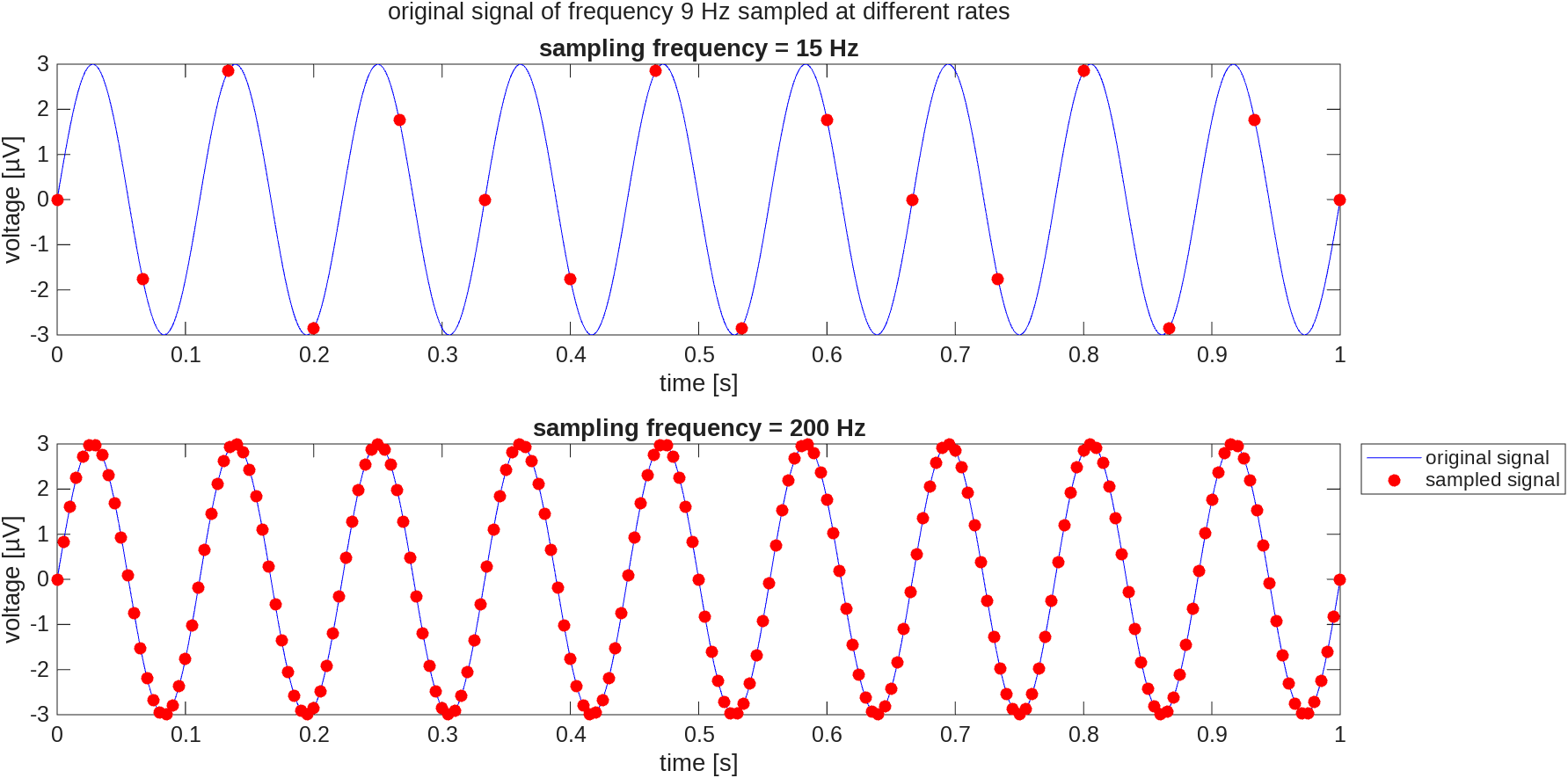
The signal acquired by the sensors and processed by the signal conditioner is an analog signal.
A continuous signal that can take any value within a certain range.
Example: Imagine an uninterrupted line on a polygraph.
The signal that the computer can store must be digital.
A digital signal is discrete (i.e., not continuous) and can only take certain values at specific time points.
Example: imagine a series of dots on a polygraph, where each dot represents a sample of the signal at a specific time point.
Digitization (or discretization) involves taking a series of samples of the analog (or continuous) signal, every so often–that is, at a certain sampling rate–and assigning a value to each sample–bit depth.
Sampling rate: how many samples are taken in a unit of time. For example, 10 Hz means 10 samples per second, 0.5 Hz means 0.5 samples per second (i.e., 1 sample every 2 seconds).
Bit depth: how many values can be assigned to each sample (e.g., 8-bit means 256 values, 16-bit means 65536 values). For example, if the signal can range from -100 to 100 microvolts, an 8-bit system would assign a value to each sample in increments of approximately 0.78 microvolts (200/256), while a 16-bit system would assign a value in increments of approximately 0.003 microvolts (200/65536).
The digitized signal is an approximation of the original analog signal. The quality of the approximation depends on how often we take samples of the analog signal (sampling rate) and how many values we can assign to each sample (bit depth).
Examples:
You are watching a video of a football game and want to take screenshots to capture the action. How often should you take the screenshots (sampling rate)? How many different colors should you use in the screenshots (bit depth)?
You are watching the clouds in the sky and want to take photos to capture their movement. How often should you take the photos (sampling rate)? How many different colors should you use in the photos (bit depth)?
Most likely, you would take screenshots more frequently and use more colors for the football game than for the clouds, because the football game has more rapid and complex changes that require a higher sampling rate and bit depth to capture accurately.
Too high sampling: you might end up with a lot of redundant information that takes up storage space and makes it harder to analyze the data.
Too low sampling: you might miss important moments in the football game (e.g., a goal) or the movement of the clouds (e.g., a sudden change in direction). Distortion due to undersampling is called aliasing.
To avoid aliasing, the sampling rate should be at least 2-5 times larger than the larger frequency contained in the signal.
Signal reduction. Term indicating the signal processing happening before statistics are run. For example:
Signal reduction can happen:
The temporal dynamics of biological activity can be classified as:
Tonic activity
Phasic activity
Change scores Typical use: describe transient changes (phasic activity) from baseline (tonic activity)
Notable types of change scores:
(A = activity; B = baseline)
Time domain. Features that develop over time. For example:
Frequency (spectral) domain. Features linked to oscillatory trends. For example:
Caveats with the acquisition and processing of each specific biological signal of psychological interest.