Foundations of scientific reading: strategy in target sports
Dr Germano Gallicchio
Lecturer in Psychophysiology and Cognitive Neuroscience
School of Psychology and Sport Science, Bangor University, UK
profile | research | software | learning resources | book meeting
On a computer press F11 to de/activate full-screen view.
For smartphone and review: Bottom left menu → Tools → PDF Export Mode.
For pdf document: use “learning resources” link above.
QR code to
these slides:
PIN
Agenda
Understand the basic structure of a scientific paper by engaging with each section: Introduction, Method, Results, Discussion
Be able to describe background and the aim of the study (Introduction)
Be able to describe what the researchers did (Method) and what they found (Results)
Be able to understand the authors’ interpretations of the findings (Discussion)
Discuss the implications of the findings
Background to the paper
Two strategies when taking a football (soccer) penalty, depending on whether the movements of the goalkeeper are considered
Keeper independent: ignore the goalkeeper
- Before the run-up, choose the target location
- Aim at the target location
- Shoot at the target location regardless of what the goalkeeper does
Keeper dependent: concentrate on the goalkeeper
- Do not choose a target location before the run-up
- During the run-up try to anticipate where the goalkeeper will dive
- Shoot in the opposite direction
Discuss in small groups: which one do you think is better and why?
Arguments in favour of the keeper independent strategy
Navarro and colleagues provide three arguments:
- There is not enough time for a keeper-dependent strategy
Time is too short to plan and execute accurate kick after goalkeeper moves. If goalkeeper initiates move within 400 ms of the kick, kickers are less likely to place ball in empty half of goal, and kicks are less precise.
- The keeper-independent strategy allows to maintain visual focus on the target
Keeper-independent strategy promotes more adaptive gaze fixations. Fixation allows for gathering of visual information, and proprioception about eye position can help control aiming action.
- Shots at the upper corner are very unlikely to be saved
Descriptive evidence from international competitions that goalkeepers cannot save shots to the corner (Armatas et al. 2007)
Biomechanical studies show that as long as you kick with moderate force (speed > 22m/s), it is impossible for keeper to intercept the ball (Kerwin & Bray, 2006)
But can we really ignore the goal keeper?
Assuming we are convinced by these arguments, we would like to adopt a goal-keeper independent strategy. But can we really employ it fully? Can we really ignore the goal keeper?
The study by Navarro et al. (2013) aims to address this question.
Assessment 1
The paper Navarro et al. (2013) is associated with assessment 1.
20 multiple-choice questions. Online submission via Blackboard. Deadline in about 1 month. Details are on the official module handbook.
Demos:
- Where to find this information in the Module Handbook and find out the deadline
PS. Can I get an extension on the deadline? Yes, it’s possible if you have valid reasons. Ask you personal tutor.
- How to access the Talis Reading List to find the full paper
- How to submit assessment 1
Note: To get the highest grade it is not enough to study these slides (the slides are not exhaustive); it is also important to study the paper, available from the Talis Reading List.
Read the paper: Introduction and Method
10:00
10 minutes
Focus on:
What were the aims of this study?
How many participants did they test? Who were they (experts, novices)?
What were the independent variables? In other words, what was manipulated?
What were the dependent variables? In other words, what was measured?
Some review questions
How many participants completed the study?
- 27
- 10
- 18
- 2
Correct response: b
What was the partcipants’ expertise?
- recreational players
- national amateur league
- national professionals
- mixed ability
Correct response: b
Which strategy did they instruct the participants to use
- whichever the players preferred
- keeper-independent strategy
- keeper-dependent strategy
- it depended on which condition
Correct response: b
How many experimental conditions did the authors use per each group?
- Each of three groups was allocated to a separate condition
- All participants performed in all three conditions
- All participants performed in all two conditions: keeper-dependent and -independent.
- It depended on the participant
Correct response: b
The three conditions used in the study
Instructions: “Hit one of the two targets”. Targets were one of the upper corners chosen by the experimenter ahead of each penalty
Conditions:
- no goalkeeper
- with goalkeeper
- with knowledgeable goalkeeper
Performance coding used in the study
hit: the ball hits the intended target
miss: the ball ends in the goal but does not hit the target
failure: the ball does not end in the goal
saved: the ball is blocked by the goalkeeper
not saved: the ball is not blocked by the goalkeeper
Dependent variable: counts of each category
Other dependent variables
accuracy (absolute error): distance from the centre of the target
precision (variable error): reciprocal of consistency in distance from the target across multiple repetitions
average speed: distance covered divided by flight time
Read the paper: Results
10:00
10 minutes
Focus on:
How did the number of “hit”, “miss”, and “failure” change across the three conditions?
How did the number of “saved” and “not saved” change across the three conditions?
How did absolute and variable error change across the three conditions?
Some results: number of hits and misses
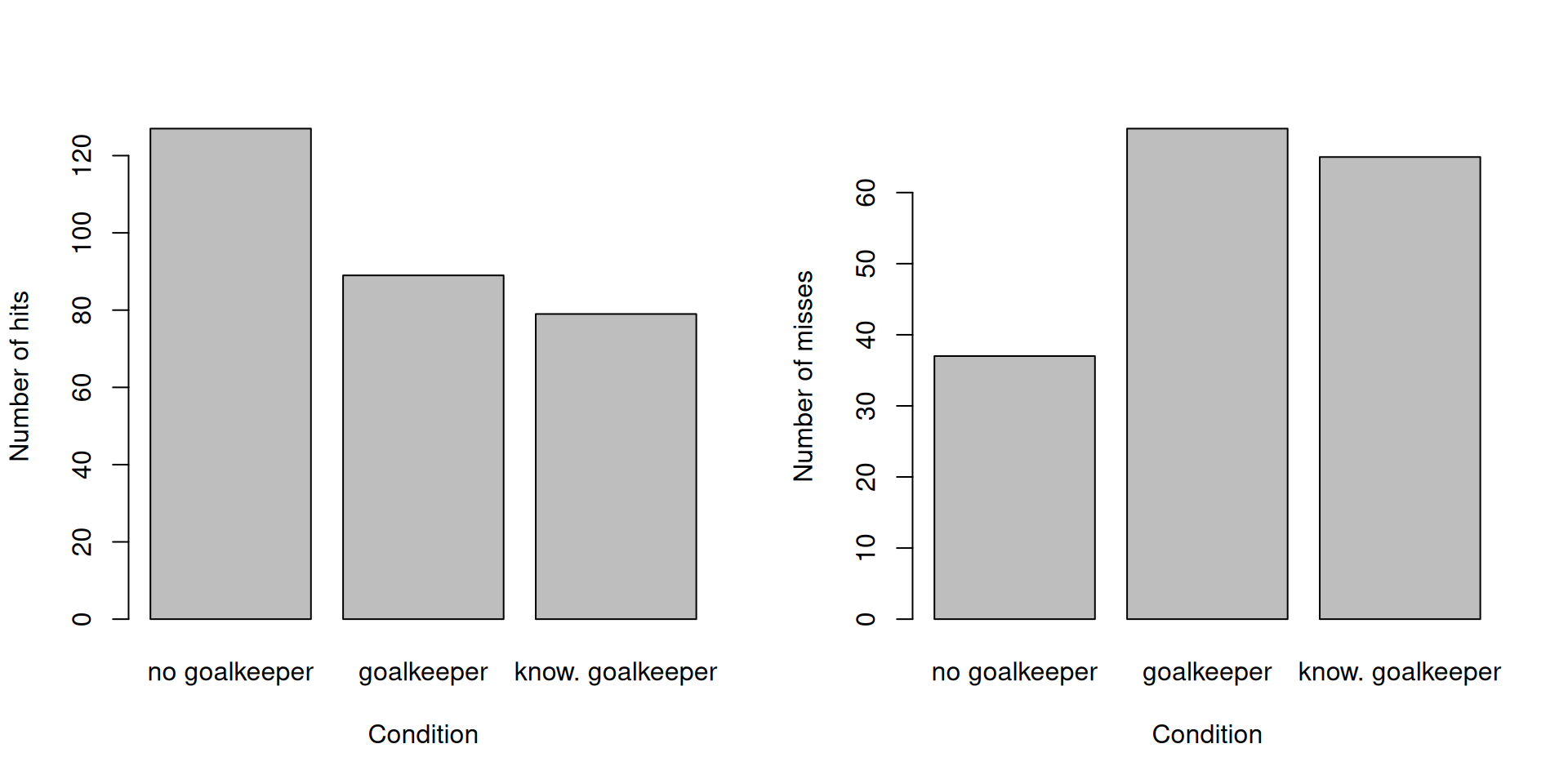
In the no goalkeeper condition, the number of hits was significantly higher and the number of misses significantly lower than the goalkeeper and knowledgeable goalkeeper conditions.
Some results: absolute error
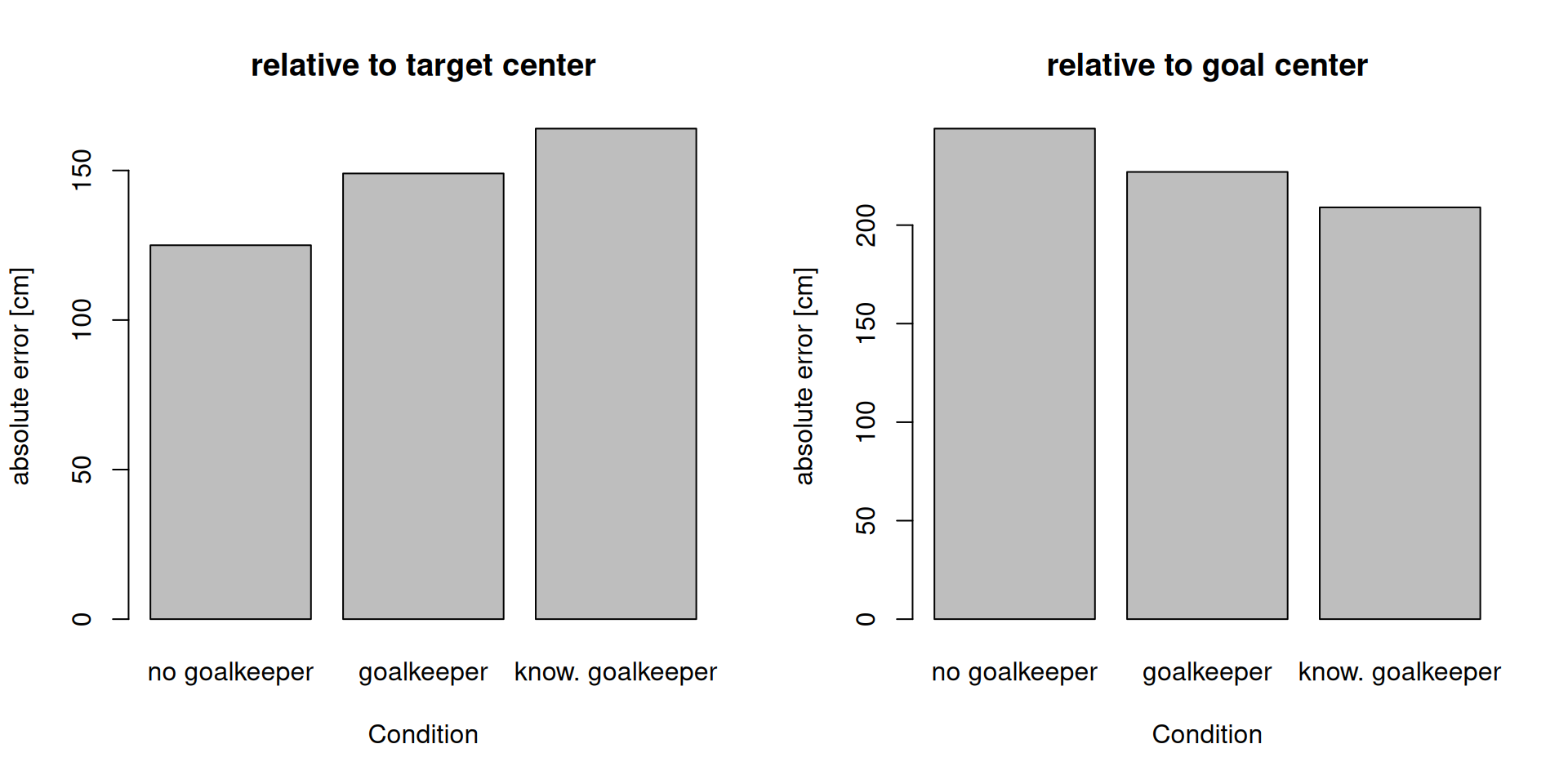
Larger absolute error for the knowledgeable goalkeeper condition compared to the other two conditions. Smallest absolute error for the knowledgeable goalkeeper condition (i.e., most centralized shots)
Read the paper: Discussion
10:00
10 minutes
Focus on:
Do the authors relate their results to any theories?
Do the authors make any applied recommendations, e.g. for sports performance or coaching?
Optional, ungraded homework:
- Try to recreate the graphs presented in these slides today. For example, use Excel or R.
Practical take-aways (based on this paper)
- Discuss how you would approach a coach who asked for your strategic advise.
Ideas: The study by Navarro et al. (2013) provided arguments for keeper-independent being better than keeper-dependent in most cases. However, they also provide evidence that adapting the keeper-independent strategy is not so easy. They also provide training recommendations.
- Anecdote. July 5, 2014 semi-finals of the 2014 FIFA World Cup in Brazil: Netherlands - Costa Rica