Lecturer in Psychophysiology and Cognitive Neuroscience
School of Psychology and Sport Science, Bangor University, UK
profile | research | software | learning resources | book meeting
On a computer press F11 to de/activate full-screen view.
For smartphone and review: Bottom left menu → Tools → PDF Export Mode.
For pdf document: use “learning resources” link above.
Last modified: 2025-12-09
QR code to
these slides:
definition of executive functions
brief anatomy of the executive functions
unity and diversity of executive functions
shifting
updating
inhibition
some executive function tasks

Set of higher order functions that control all cognitive processes
Like the director of an orchestra executive functions control:
which cognitive functions are silenced/heightened at a certain time
How cognitive functions are coordinated
Main function: executive functions allow to control behaviour, cognition, and emotions

Executive functions rely on a distributed network, involving several cortical and subcortical regions (i.e., nodes of the network) and their connections (i.e., edges of the network).
Traditionally, the prefrontal cortex (often shortened as PFC) is attributed a the role of an important node within this network.
Key cortical regions along with the main functions they enable:
| Region | Abbreviation | Key Functions |
|---|---|---|
| Dorsolateral prefrontal cortex | DLPFC | Working memory, goal maintenance, planning and top‑down control |
| Ventrolateral prefrontal cortex | VLPFC | Response selection, inhibition, and controlled retrieval |
| Orbitofrontal cortex | OFC | Value representation, reward-guided decision making and impulse control |
| Anterior cingulate cortex* | ACC | Conflict monitoring, error detection, and performance adjustment |
| Parietal cortex | - | Attentional reorienting, representation updating and integration with sensory information |
| Premotor cortex / supplementary motor area | SMA | Action selection and motor planning |
*Note: anatomically it lies just outside the prefrontal cortex but it works in synergy with it
Key subcortical regions are basal ganglia, thalamus, cerebellum
Inter‑species differences in the mass of the PFC relative to the whole cerebral cortex

Relative to total cortical mass, the prefrontal cortex (PFC) is disproportionately large in primates (and especially in humans).
This may be the neural substrate to the greater executive function skills in primates compared with non-primates.
However, a bigger structure does not always lead to better function. Connectivity is also important.

Frenology is a historical theory, now discredited, suggesting that the shape and size of the skull can determine a person’s character and mental abilities.
Some key concepts:
Despite getting the wrong answer, phrenology gets the credits for sparking important questions about the localization (in the brain) of cognitive functions.
Neuropsychology first and neuroscience later confirmed that each cortical region plays key roles in networks responsible for specific cognitive functions.
Earlier evidence for the connection between structure and function came from lesion studies: clinical assessment of patients with selective lesions to the cerebral cortex.

The first well documented case of selective lesion to the PFC.
A railroad worker at the time. In an accidental explosion, a metal rod passed through his skull. He survived. But he became a different person.
Before the accident: responsible and smart.
After the accident: Able to walk and talk. But unable to control himself, impatient, impulsive, showing socially inappropriate behaviour, and no inhibition.
Seminal study evaluating quantitatively the commonalities and differences among several multiple executive-function tasks and the functions they represent.
They used a variety of tasks to measure each of three functions, upon which there was growing consensus as being the core executive functions:
Two key conclusions:
the three core executive functions are separable: each explains a unique aspect of cognitive control.
the three core executive functions are correlated: each contributes to explaining general aspects of cognitive control.
This unity and diversity framework revolutionized how researchers conceptualize executive functions. Not as a single construct, but as three separable but moderately correlated functions.
Inhibition refers to the ability to suppress dominant responses that are inappropriate or not relevant in a certain situation.
How you might experience inhibition:
Key properties of inhibition tasks:
Key performance metric:
The Stroop task involves a conflict between the meaning of a word and the color of the ink it is printed in.
Key features in a trial:
Key outcome measures:
There are variations:
The Flanker task involves resolving a conflict between a central target stimulus and surrounding flanking stimuli.
Key features in a trial:
Key outcome measures:
There are variations:
Being able to maintain and manipulate information in working memory.
How you might experience updating:
Mental arithmetic: keeping track of running totals while calculating (e.g., ,mentally adding up the cost of items in a shopping basket)
Phone number exchanging: memorizing a phone number you have just been told, except they tell you “sorry, the third to last digit was 5”
Navigation: remembering the sequence of turns you have taken to find your way back
Key properties of updating tasks:
Key performance metrics:
You see a continuous stream of stimuli (e.g., letters, digits, sounds, or locations). Each stimulus is presented for a short duration, and there might be a small gap until the next stimulus.
Your task: for each stimulus, decide if the current item matches (i.e., is identical to) the one from n steps earlier. A stimulus requiring a decision forms a trial.
Common levels:
Key features in a trial:
Stimulus modalities:
Key outcome measures:
There are variations:
Being able to flexibly switch between tasks or rules.
How you might experience shifting:
Language: switching language when translating to/from two languages
Driving: shifting from following the navigation system to reacting to unexpected roadworks
Home life: pausing cooking to answer the door
Navigation on phone: switching from map view to messages and back
Sports: switching from offense to defense
Key properties of switching task:
Key performance metrics:
Switch cost: how slower and less accurate you are in switch trials vs repeat trials
Mixing cost: how slower and less accurate you are in repeat trials vs pure trials
You are presented with a pair of a digit and a letter (e.g., 3T).
Task A: Digit task
Task B: Letter task
How they alternate:
There are variations:
You are presented with a spoken number (e.g., “three”, “eight”).
Task A: Odd/Even Task
Task B: Magnitude Task
How they alternate:
You are presented with a Navon stimulus.
Navon stimuli consist of large letters or shapes made up of smaller letters or shapes. For example, a large “H” might be composed of many small “S” letters.
This design allows for two levels of processing: the global level (the large letter) and the local level (the small letters).
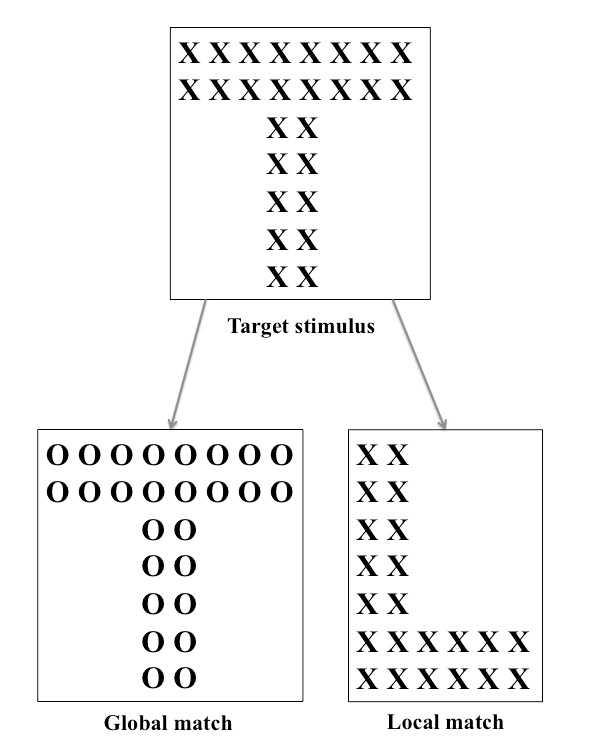
Task A: Global Task
Task B: Local Task
How they alternate - A cue tells you which task to perform - The cue could be the colour of the Navon figure or the tone of a sound
In small groups, pick a scenario and map each activity to an executive function (note: an activity could map onto more than one executive function).
Olympic gymnast:
Air Traffic Controller
a student
The three core executive functions studied by Miyake et al. (2000) are important because they can be considered building blocks for higher-order functions, but they are not exhaustive.
Some additional functions considered executive functions include:
Planning and problem solving
Goal setting and maintenance
Performance monitoring and error detection
Cognitive flexibility beyond simple shifting (e.g., creativity)
Decision‑making and value‑based control in some models