Lecturer in Psychophysiology and Cognitive Neuroscience
School of Psychology and Sport Science, Bangor University, UK
profile | research | software | learning resources | book meeting
On a computer press F11 to de/activate full-screen view.
For smartphone and review: Bottom left menu → Tools → PDF Export Mode.
For pdf document: use “learning resources” link above.
Last modified: 2025-11-24
QR code to
these slides:
PIN
Definition of attention
Visuospatial attention and its typologies
Spatial cueing effects
Attention and deception in sports
William James
Everyone knows what attention is. It is the taking possession by the mind, in clear and vivid form, of one out of what seem several simultaneously possible objects or trains of thought. Focalization, concentration of consciousness are of its essence. It implies withdrawal from some things in order to deal effectively with others, and is a condition which has a real opposite in the confused, dazed, scatterbrain state.
point 1: We can choose the focus of attention. Attention can be voluntary.
point 2: Inability to attend to many things at once
point 3: Limited capacity to process information. Attention is a selective process
These videos are meant to demonstrate we don’t notice obvious changes when we don’t pay attention to them.
There are several theoretical models of visuospatial attention (but we will not go through each of them)
It is useful to think of attention as a spotlight moving in space

Selecting a certain location or object in space, so that processing of those stimuli is facilitated.
Events occurring in that location (vs those occuring in another location):
Orienting of visuospatial attention = aligning of attention with a source of sensory input or with an internal representation (memory)
Keep your gaze on the center while reading the letters appearing on screen.
+ C O V E R T
Important distinction in the manner visuospatial attention can be oriented.
covert orienting: attention is directed in space independently of the sensorial organs (e.g., direction of eyes or head)
overt orienting: Directing the sensorial organs towards the region of space of interest.
Overt orienting
Introductory video (scene from the movie “Back to the Future”)

Michael Posner
The spatial cueing task is a experiment used to study how attention is directed in space. It helps us understand how cues can guide our focus, even without moving our eyes or head. How does the task work?
There is a catch: the cue does not always tell the truth.
Valid cue
Invalid cue
Neutral cue
Auditory version
Cue: a brief tone presented to either the left, right, of both ears
Target: another brief tone presented to either left or right ear
Task: Press a button as quickly as possible when you hear the target
Tactile version
Cue: a brief vibration presented to either the left, right, or both hands
Target: another brief vibration presented to either the left or right hand
Task: respond with your voice as soon quickly as possible when you feel the vibration
Exogenous orienting: Associated with signals that capture attention automatically and involuntarily (like a sudden flash or sound). It is fast and reflexive.
Endogenous orienting: Associated with symbolic signals (like an arrow or instruction) that provide information about a location. Attention is then oriented voluntarily (intentionally).
In other words, there are two ways that attention can be shifted:
Endogenous shift = “from inside”, goal-directed, top-down (you control it)
Exogenous shift = “from outside”, stimulus driven, bottom-up (the environment controls it). Sometimes associated with a distracting stimulus.
| Exogenous cue | Endogenous cue | |
|---|---|---|
| Visual modality | a flash in a location | an arrow pointing at a location |
| Auditory modality | a tone in a location | a tone pointing at a direction (e.g., a voice saying “right”) |
The previous demonstration included only endogenous cues was
Valid cue The cue is a flash on the left. A short while after, the target appears also on the left. In this trial, the cue was valid.Michael Posner used a spatial cueing task to investigate how attention is directed in space. Participants were asked to fixate on a central point while cues indicated where a target might appear.
The cues could be valid, invalid, or neutral. After a brief delay, the target appeared, and participants responded as quickly as possible. The study measured response times to the onset of the target.
The classic Posner study focused on endogenous (central, symbolic) cues such as arrows presented at the center. Exogenous cues (such as peripheral flashes) were introduced in later studies.
Participants were required to keep their eyes on the fixation cross the whole time.
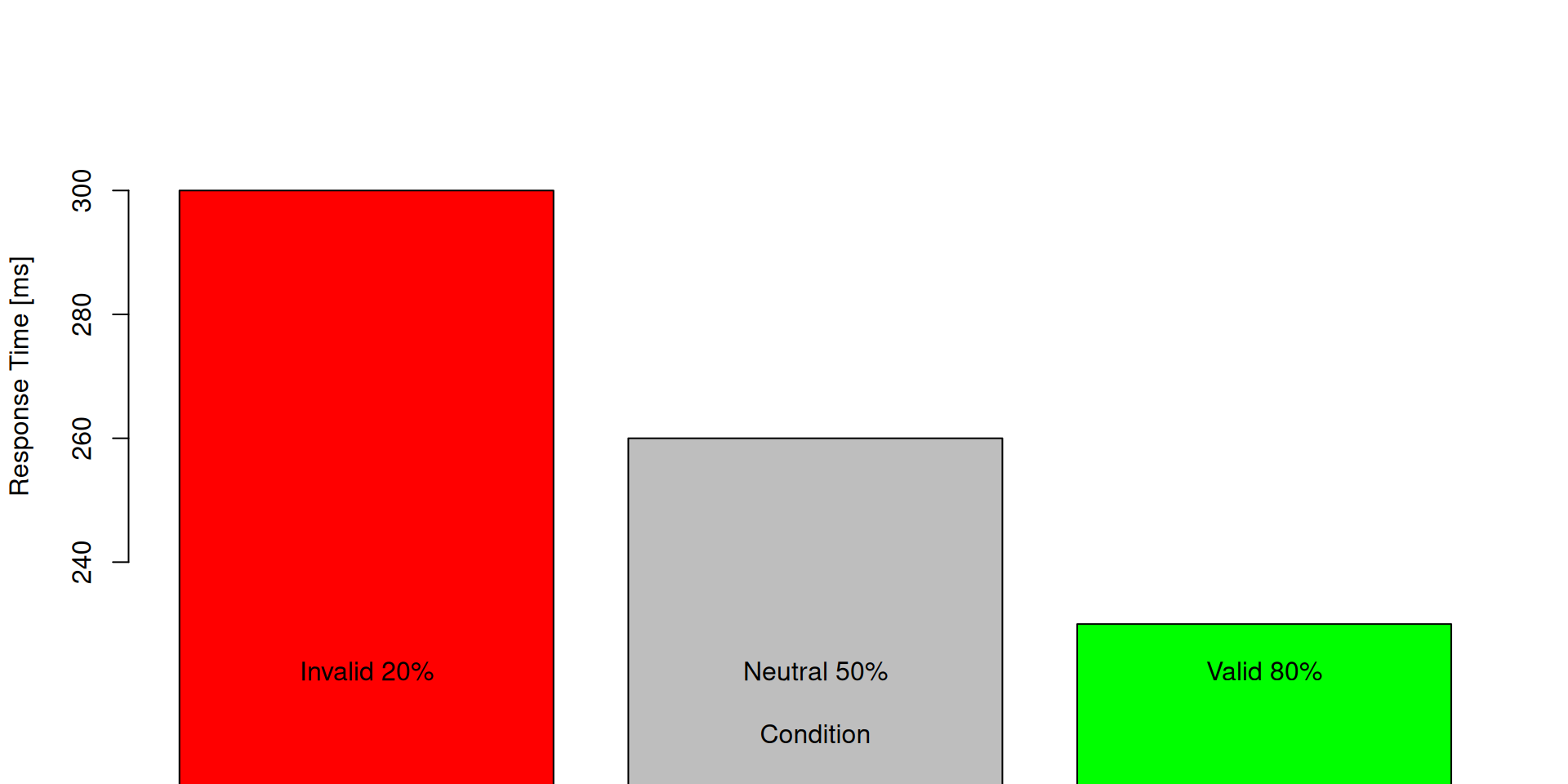
The classic design typically used 80% valid, 20% invalid, and 50% neutral trials as a separate baseline.
Note
The percentages refer to the distribution of trial types within the experiment, not to a single set of trials. Typically, the experiment is structured so that, for example, 80% of the cued trials are valid and 20% are invalid, while neutral trials are presented as a separate baseline (often making up 50% of the total trials, or sometimes 1/3 if all three types are equally represented). The numbers in the example above are illustrative and not meant to sum to 100% in a single block—they describe the proportions within each trial type.
| trial type | function |
|---|---|
| neutral | serve as a control condition for the other two |
| valid | study the benefits of attending to the correct location |
| invalid | study the costs of attending to the wrong location |
Questions:
Why did Posner decide to make the cue 80% of the times valid? Why not 100%?
If it were 100%, then the cue would never be invalid, and Posner could not study the cost of attending to an incorrect location
Why then 80-20% and not 50-50%?
To build trustworthiness in the cue: the participant oriented their attention to the cued direction because most of the times the cue pointed in the correct direction. If the participant learned over time that the cue was uninformative, they would stop using
Were participants supposed to orient their attention overtly or covertly?
Covertly. In fact, they were required to keep their eyes on the central fixation cross.
Key result:
Key interpretation:
Valid cue pre-activates a an attentional path which is the same as that activated by the target
Invalid cue pre-activates a an attentional path which is different from that activated by the target
Most later studies are more complex than this.
One (of many) idea: a valid cue does not always cause facilitation…
How can it be? Any ideas?
If the cue is exogenous and the cue-target delay is longer than expected, the target is detected more slowly
This phenomenon is known as inhibition of return (however, this is not topic for this module)
Try the task yourself at: link to Psytoolkit demo
Make sure to read the paper
Overarching aim: determine whether expert basketball players are better than novices in distinguishing true from fake passes
picture of basketball game. decorative reasons only.
Participants
Task
Main measure
Both experts and novices performed above chance level, for both movies and pictures: they could distinguish fakes from passes
Experts outperformed novices (i.e., they gave more correct responses) when movies were presented
Participants
Task
Main measure
Novices performed at the chance level
Experts performed above chance: they could distinguish fakes from passes
Experts performed better when watching from the front than from half-profile
Interpretation:
visual expertise
motor expertise
How would you follow-up this study?
example: track gaze position to identify which information experts and novices use
Social spatial cueing
Directional changes in posture (e.g., eye movements) of a person can influence somebody else’s direction of attetnion.
Sport fakes?