Attentional Control Theory


Dr Germano Gallicchio

Lecturer in Psychophysiology and Cognitive Neuroscience

School of Psychology and Sport Science, Bangor University, UK

profile | research | software | learning resources | book meeting


On a computer press F11 to de/activate full-screen view.

For smartphone and review: Bottom left menu → Tools → PDF Export Mode.

For pdf document: use “learning resources” link above.

Last modified: 2025-11-24

QR code to
these slides:


PIN

0000

Part 1 of 2

Agenda

  • Brief review on attention and working memory
  • Effects of anxiety
  • Processing Efficiency Theory
  • Quiet Eye phenomenon
  • Mixture of theory, empirical research, and intuition

Brief review of working memory

F two key features L limited capacity F->L M multiple components F->M

We will review these features in turn.

Working memory has limited capacity (feature #1)

Think of working memory as the set of resources for temporarily holding and manipulating information.

Analogy used often: a working desk. There is enough space for the things you are working on right now, not much else…
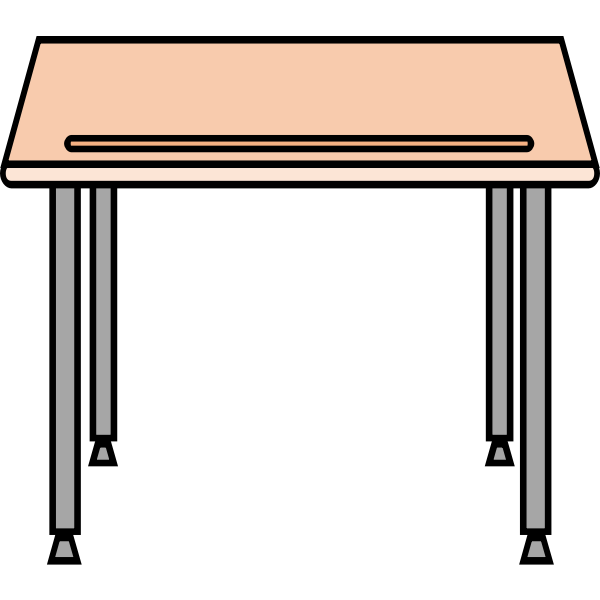
School desk

Desk analogy

The white rectangle is the desk, representing how much working memory is being used at this moment. Currently: unlikely/impossible situation where nothing is taking space in working memory

Desk analogy

Most of the times (or always) something occupies space on the desk: the things that are in the working memory. Sometimes one has enough working memory capacity spare to do well whatever it is that one is doing.

Desk analogy

Other times, there’s too much in working memory and the system fails due to overload (running out of cognitive resources). Whatever one is doing is going to suffer in quality.

Measuring working memory capacity: span

Classic span tasks measure primarily (short-term) storage capacity: participants hear or see sequences of items (digits, letters, words) and must recall them in order. Span is the maximum number of items a person can correctly repeat, often reported to be around 7 +- 2.

These tasks involve mainly two relatively-simple processes: encoding and recall.

Optional: Link to demo of digit span task

Working memory’s multiple components (feature #2)

photo of Alan Baddeley from the University of York public website
Alan Baddeley

Three different components handle storage of information (e.g., visuo-spatial, verbal-phonological) or manage access to that information.

A central executive B phonological loop A->B C visuospatial sketchpad A->C

House windows exercise

Helpful to realize how the three components work together.

Take a couple of minutes to work out how many windows are there in your house

  • You retreive from long-term memory and manipulate a mental image of your house as you “walk through” it room by room (visuospatial sketchpad)

  • As you progress, you keep a count of the number of windows by rehearsing the numbers out loud or not. (phonological loop)

  • You will have followed a strategy: deciding which rooms to visualize next, keeping track of progress, and ensuring the count is updated (central executive).

Combining the two features: Measuring component-specific capacity

Phonological/Verbal Working Memory:

  • Digit Span: Recall sequences of digits in order
  • Letter Span: Recall sequences of letters in order
  • Word Span: Recall sequences of words in order

Visuospatial Working Memory:

  • Corsi Block Tapping Test: Recall sequences of spatial locations. Optional: link to Corsi span test
  • Visual Patterns Test: Recall patterns in a grid

Optional: Complex span tasks

Classic span tasks = measure how much you can hold.

Complex span tasks = measure how well you can hold information while doing something else.

They require to:

  • resist interference from additioanl processing task
  • keep the memory items active

Compared to classic span tasks, better association with higher-order cognition (executive functions)

Example: link to the operation span task

Attention

Working memory’s limited capacity (feature #1) implies that one can’t process all information at once. One needs to select and that’s one of the things attention does

Orienting of attention: endo- vs exo-genous

Endogenous

  • “endo” = from the inside
  • voluntary, intentional
  • determined by the person
  • top-down
  • goal-directed

Exogenous

  • “exo” = from the outside
  • involuntary, not intentional
  • determined by the environment
  • bottom-up
  • stimulus-driven

“Cocktail party” scenario: demonstrating goal-directed (endogenous) and stimulus-driven (exogenous) attentional orienting

Cocktail party
Designed to illustrate selective feature of attention at the preconscious level, but here merely a shortcut for me to illustrate goal-directed and stimulus-driven attention at play.

You are in a noisy place. You choose to attend to one speaker (goal-directed). Suddenly, your attention is captured (distracted) by a salient, personally relevant cue (like hearing your name from your back) (stimulus-driven).

Important: the extent of attentional control can be defined as the balance between goal-directed (concentration) and stimulus-driven (distraction) attention

Orienting of attention: overt vs covert

Overt

  • observable orienting movement of sense organs/body
  • attention shifts with sensor orientation (eyes, head/ears, posture)
  • typically detectable by others
  • examples:
    • visual: turning eyes/head to look at a clock
    • auditory: turning your head or cupping your ear toward a speaker
    • tactile/proprioceptive: moving a finger to explore a texture

Covert

  • internal shift of focus without observable movement
  • attention shifts without changing sensor orientation
  • typically not detectable by others
  • examples:
    • visual: keeping eyes fixed but monitoring something in peripheral vision
    • auditory: keeping head still but following a conversation behind you
    • tactile/proprioceptive: keeping the hand still but focusing on the pressure of a ring

Demonstrating overt vs covert

While fixating the cross at the centre, try to read what appears at the sides


COVERT + ORIENTING


You just experienced covert orienting

Types of attentional orienting: a 2 x 2 framework

Goal-directed orienting can happen overtly or covertly. Stimulus-driven orienting can also happen overtly or covertly.

O orienting A overtly O->A B covertly O->B C goal-directed A->C D stimulus-driven A->D E goal-directed B->E F stimulus-driven B->F

Examples

Overt Covert
Goal-directed Deliberately turning your head to look and focus where your team-mate will pass While dribbling look to your right but mentally tracking your team-mate running to your left
Stimulus-driven In a tennis tournament, someone in the crowd shouts your name A motorbike racer keeps their eyes locked on the track at a difficult turn but their attention is automatically pulled to a crash happening in their peripheral vision

End of the brief review on working memory and attention

Reflect on the main things you did not remember about working memory or attention

What does anxiety do to attentional control?
just a meme about anxiety. no real content

A anxiety B trait (dispositional) A->B C state (situational) A->C

A anxiety B somatic A->B C behavioural A->C D emotional A->D E cognitive (aka: worry) A->E

Shapiro & Johnson (1987)

Study 1, key methodology

  • N = 30 University students
  • Task: Use one hand to classify central and peripheral target stimuli (perceptually difficult because the target stimuli were presented for a short duration)
  • Participants needed to keep their eyes on a central fixation cross. A target stimulus could appear either centrally or in the periphery … or both: dual trial (i.e., two targets at the same time)
  • Groups: arousal, non-arousal
  • The other hand was for receiving electrical shocks every now and then, but only the lucky ones in the arousal group.
  • Analyses: the researchers were interested in the participants’ choices in the dual trials.

Study 1, main results
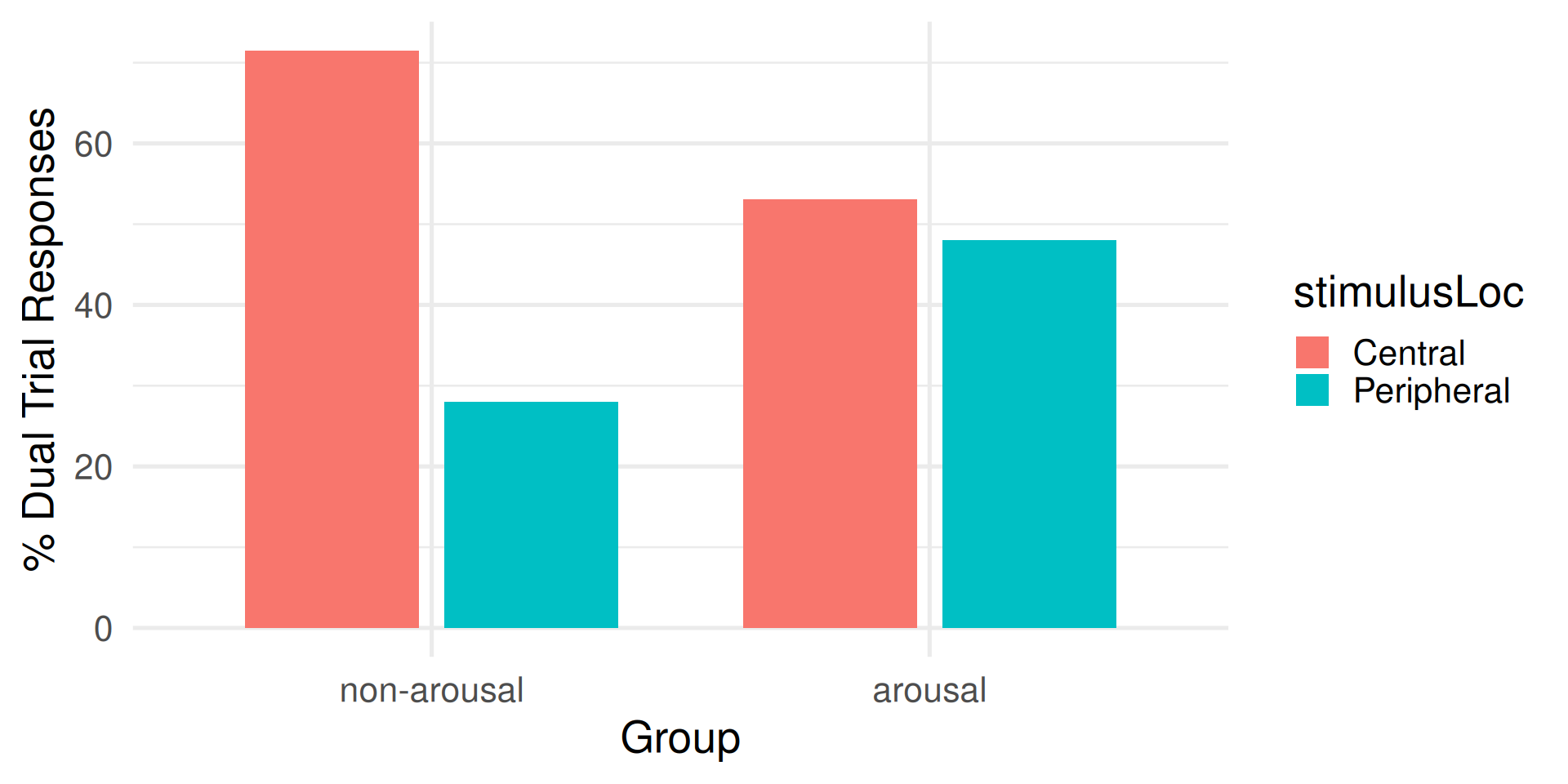
For the non-arousal group, dominance of central stimulus

For the arousal group, no dominance. Arousal countered the dominance of the central stimulus.

Shapiro & Johnson (1987)

Study 2, key idea

They realized the central stimulus was more predictable (only one location) than the peripheral stimulus. In study 2, they used the same Method, but made the central location less predictable than in study 1.

Study 2, main results
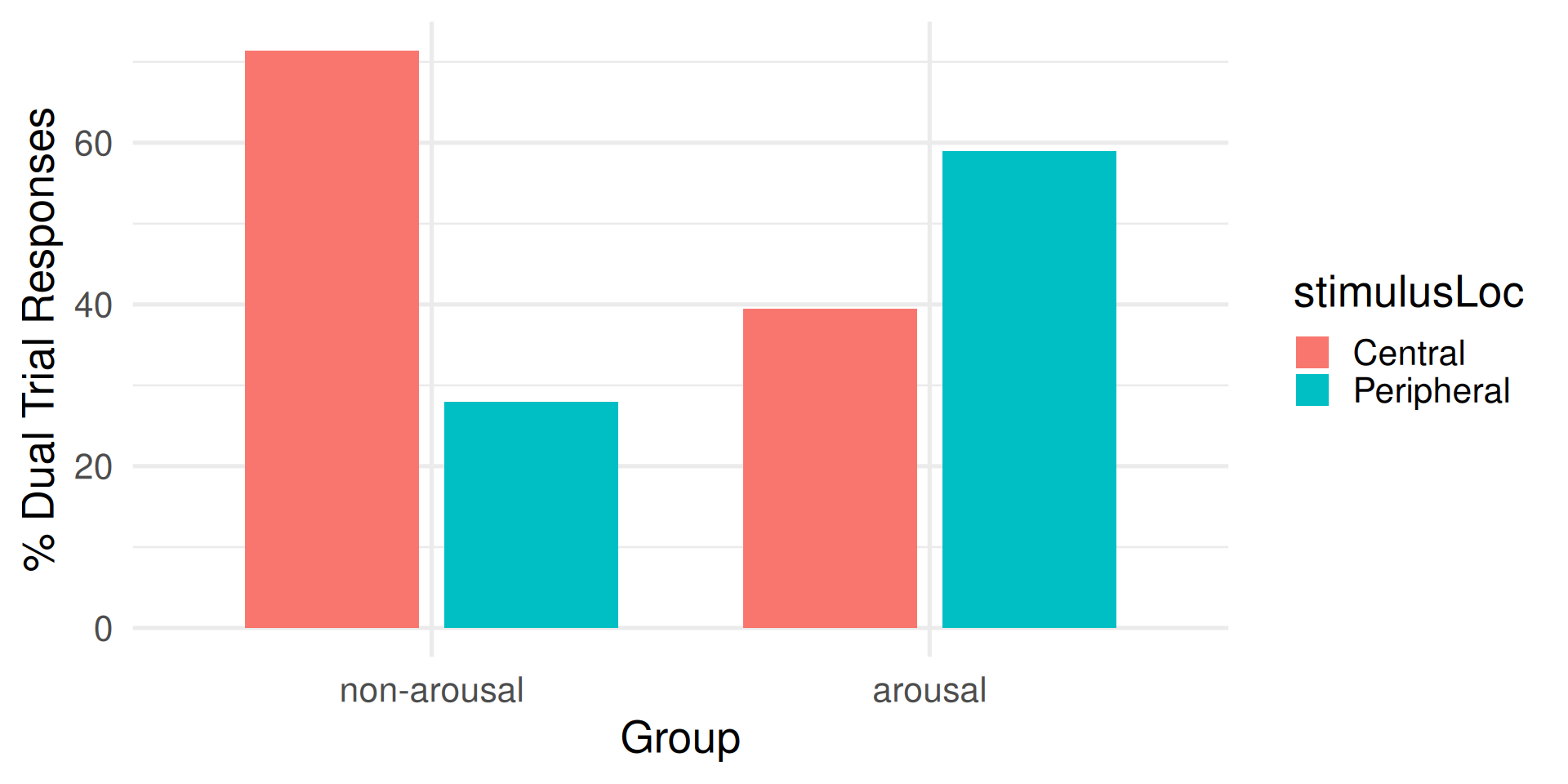
Arousal reversed the dominance, so that when a pair of central-peripheral targets were presented, the peripheral target became the dominant.

Lipp & Derakshan (2005)

Key methodology:

  • N = 70 participants
  • Groups:
    • Spider/snake phobics
    • non-phobics
  • Task: emotional dot probe
  • Emotional Dot probe: a cue appears on the screen either left or right before a target stimulus appears either left or right. The cue could be neutral or emotional (image of a snake).

Main results:

  • The target was detected faster when appearing shortly after an emotional cue
  • Larger effects for phobics

Lautenbach et al. (2016)

Key methodology:

  • N = 40 athletes
  • Task: emotional Stroop task
    • A: negative sport related words (e.g., defeat, failure, rival)
    • B: neutral sport related words (e.g., endurance, position, sideline)
    • C: neutral non-sport related words (e.g., radio, lemon, computer)

Main results:
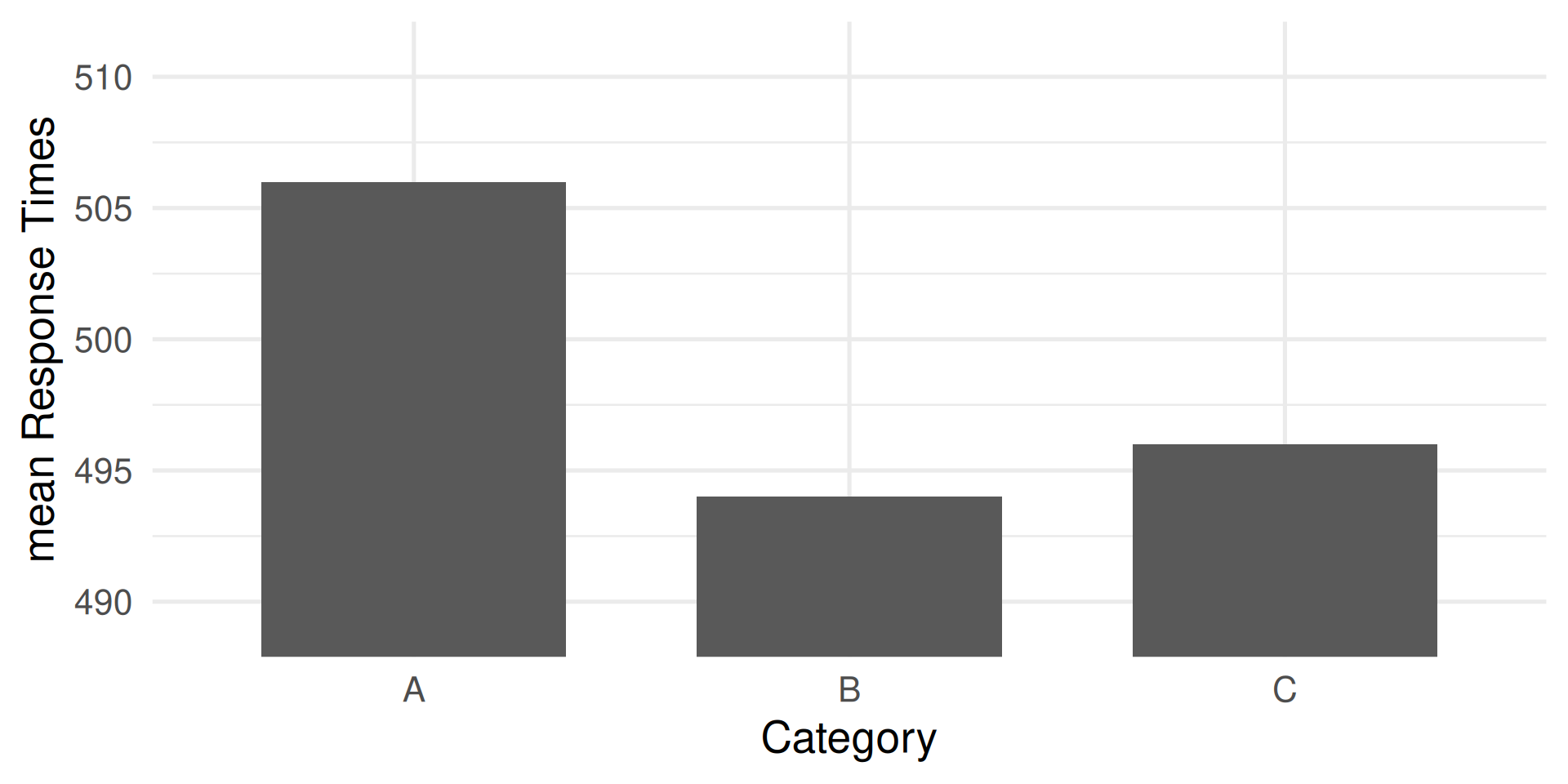
Significantly slower when responding to negative sport-related words.

Summary of effects of anxiety on attention: Attentional Bias

Anxiety induces an attentional bias, consisting of enhanced processing of threats:

  • early detection of threats
  • impaired disengagement from threats

(whatever threat means to the individual).


Good or bad? Neither. From an evolutionary perspective, anxiety is an adaptive process that increase chances of survival. But thinking about threats might not always be the most functional way to use one’s working memory resources.

Processing Efficiency Theory (PET)

There are plenty of resources (white) to complete an easy task (yellow). Performance is good.

Processing Efficiency Theory (PET)

Resources dedicated to worry (blue) are not dedicated to process task-related information. But there are plenty resources for both. Performance is good.

Processing Efficiency Theory (PET)

If worry takes more resources (i.e., one experiences greater cognitive anxiety), while still leaving enough for the easy task, there is still space for both. Performance is still not impaired.

Processing Efficiency Theory (PET)

But if the task is more difficult requiring more resources, and if there are none left, performance will be impaired.

Performance is impared if there are not enough resources to carry out the task. Worry is a distraction that takes resources away from the task

Processing Efficiency Theory (PET)

However, working memory capacity can temporary increase, through effort mobilization. There are now enough resources for both the worry and the task. Performance is good. However, the fact that extra resources were mobilized means decreased efficiency.

Processing Efficiency Theory (PET)

In fact, even a task so difficult could have been carried out well in a more efficient manner (i.e., without the extra effort) if worry did not occupy so much of working memory.

Processing Efficiency Theory (PET)

The effects of worry (cognitive anxiety) are best studied not on performance, but on processing efficiency.

Note

Optional: my interpretation \[ \text{efficiency} \propto \frac{\text{performance}}{\text{resources}} \]

The formula is a short version of “how much you do in relation with how much effort you put tells about efficiency”. The symbol \(\propto\) means “is proportional to”.

Smith et al. (2001)

Key methodology:

  • N = 12 volleyball players
    • 6 low and 6 high in trait anxiety
  • Task: Eigth volleyball games
  • Measures:
    • State anxiety (through questionnaire)
    • Effort mobilized (through questionnaire)
    • Performance (through video analyses)
  • Analysis factors
    • Group (low, high trait anxiety)
    • set criticality
      • low: 7 or more points of difference
      • moderate: between 3 and 6 points of difference
      • high: less than 2 points of difference

Predictions:

  • State anxiety would be greater for more critical sets
  • Effort would also be greater for more critical sets
  • Performance would increase when more effort is mobilized
    • but only for the low-trait anxiety group

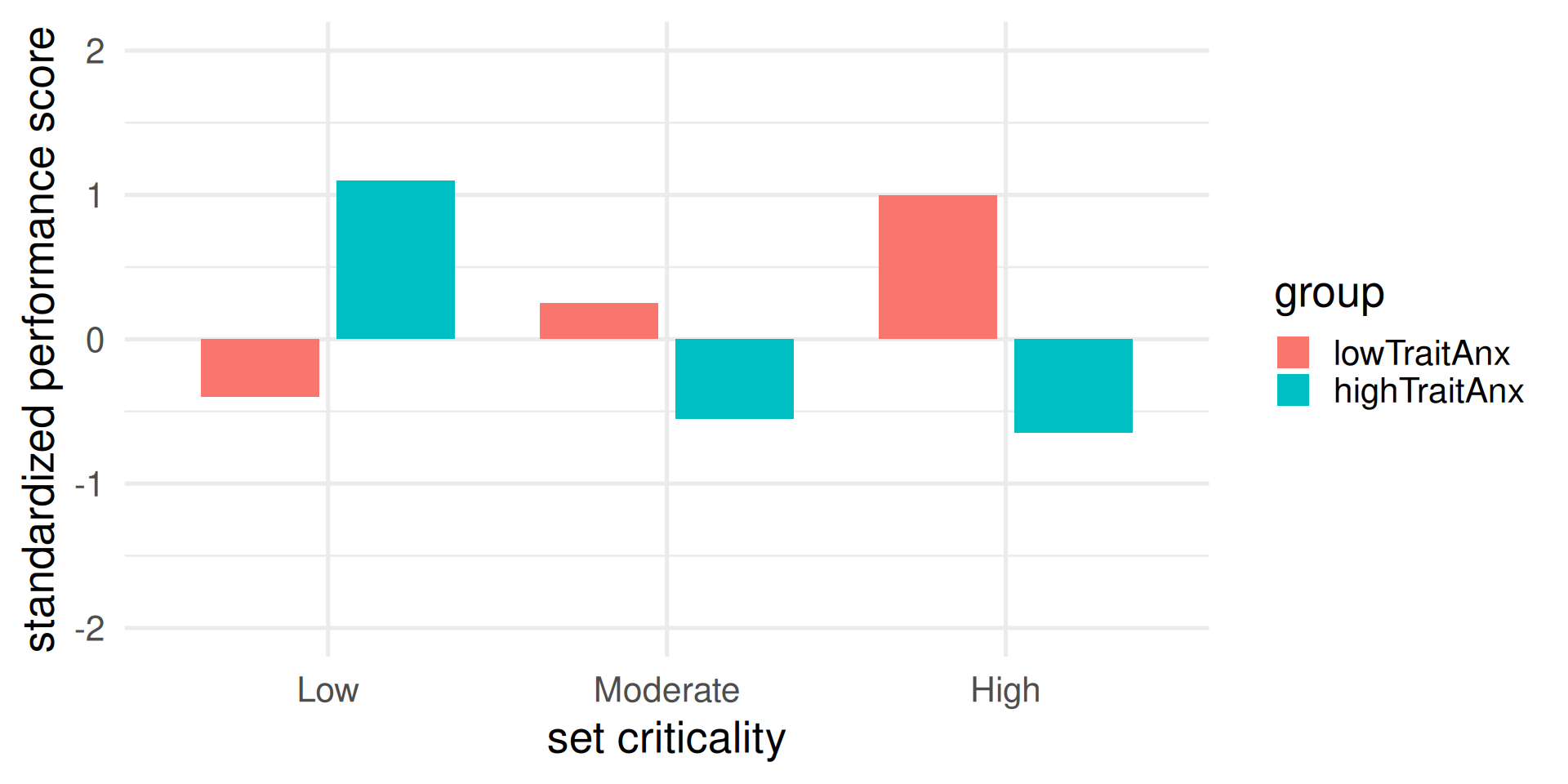
Main results:

  • High-trait anxiety groups experienced greater state anxiety
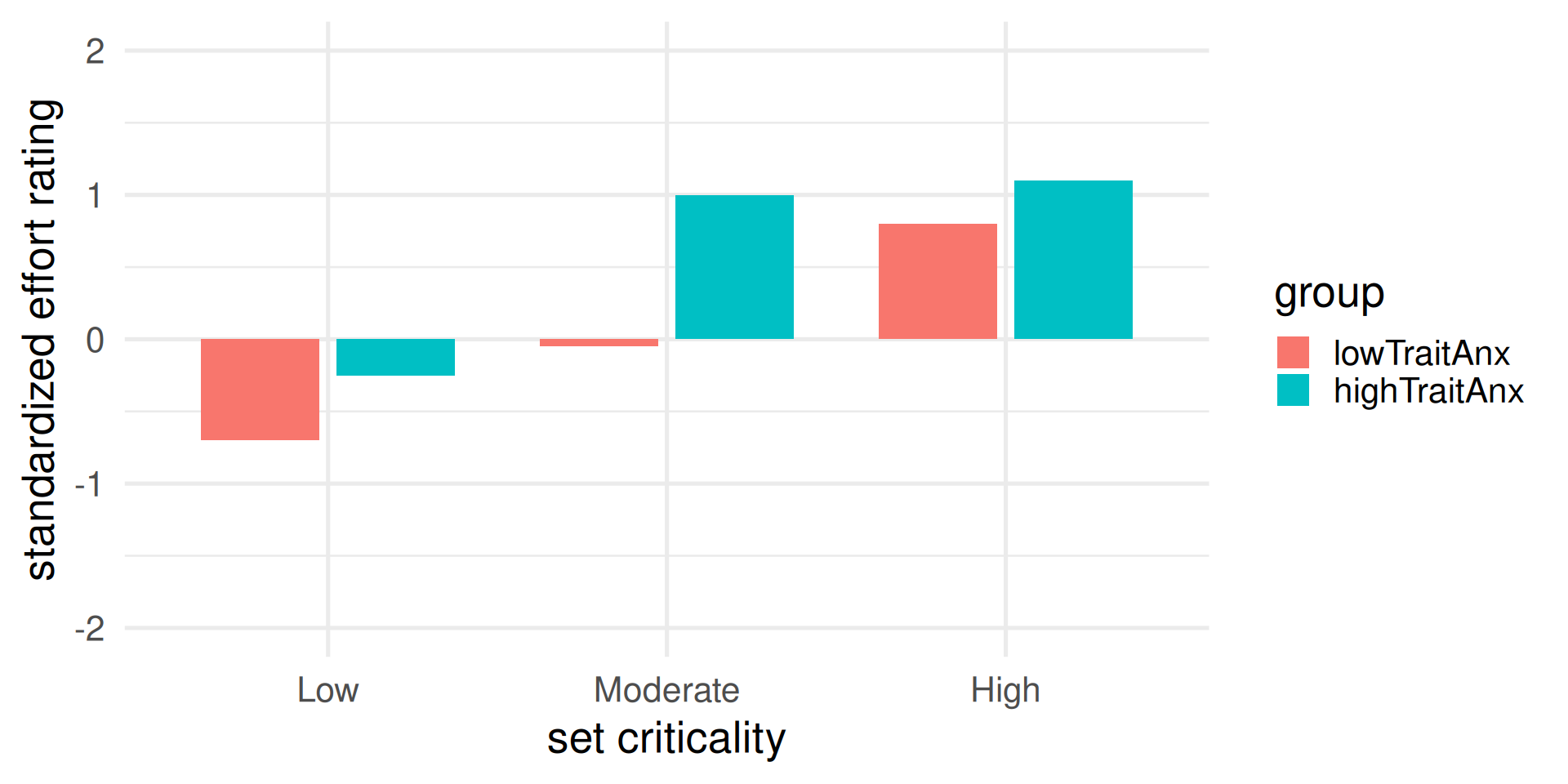
  • Effort increased with set criticality

  • Performance improved with set criticality for the low-trait anxiety group
  • Performance declined with set criticality for the high-trait anxiety group

Interpretation: Performance and worry competed for resources. As worry (state anxiety) increased over set criticality, fewer and fewer resources were left to focus on the volleyball task. Some support for Processing Efficiency Theory

Visuospatial attention in target sports: the quiet eye

photo of Joan Vickers Joan Vickers

“Quiet Eye” as much a phenomenon as a variable.


As a variable

  • The QE is a duration of time, units of (milli)seconds
  • Eyes on the critical location or object (e.g., ball in golf putting)
  • It starts before movement initiation (“QE onset”)
  • It ends when the gaze deviates from the location or object of a certain amount (“QE offset”)

As a phenomenon

Extensive reports in literature that:

  • experts have a longer QE than novices
  • QE is longer for successful than unsuccessful performance
  • it is trainable

Mechanisms / What happens during the QE that is beneficial to performance?

  • Visual processing
  • Postural-kinematic quiescence
  • a few others…

Wilson & Pearcy (2009)

Key methodology:

  • N = 6 participants
  • Task: Golf putting on flat and sloped surfaces
  • Measure:
    • Performance
    • Quiet Eye duration via eye tracking

Key result:
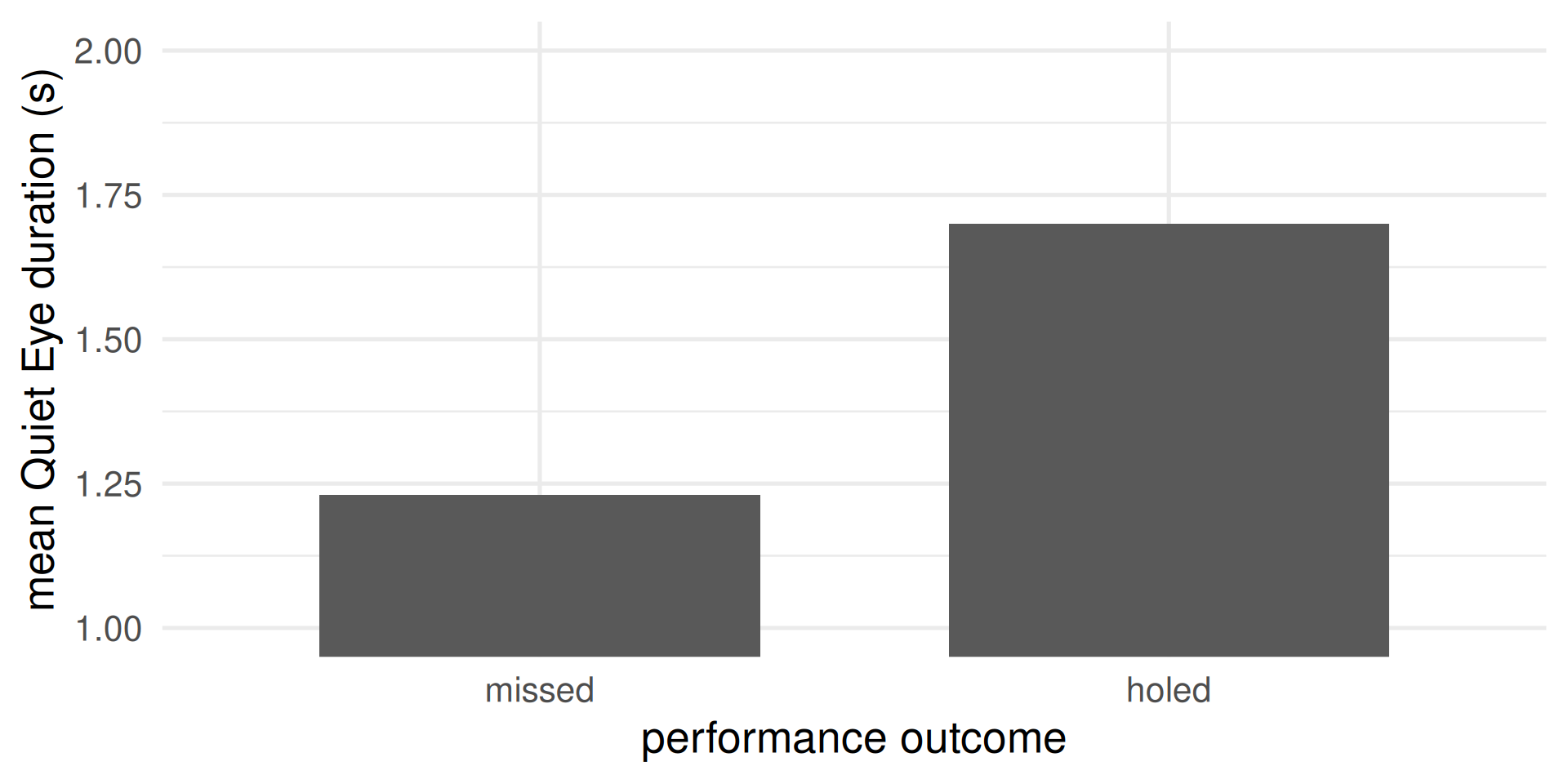
Significantly longer QE durations ahead of holed than missed putts.

Walters-Symons, Wilson, & Vine (2017)

Key methodology

  • N = 18 experienced golfers
  • N = 21 novice golfers
  • Task: flat-surface golf putting

Key result
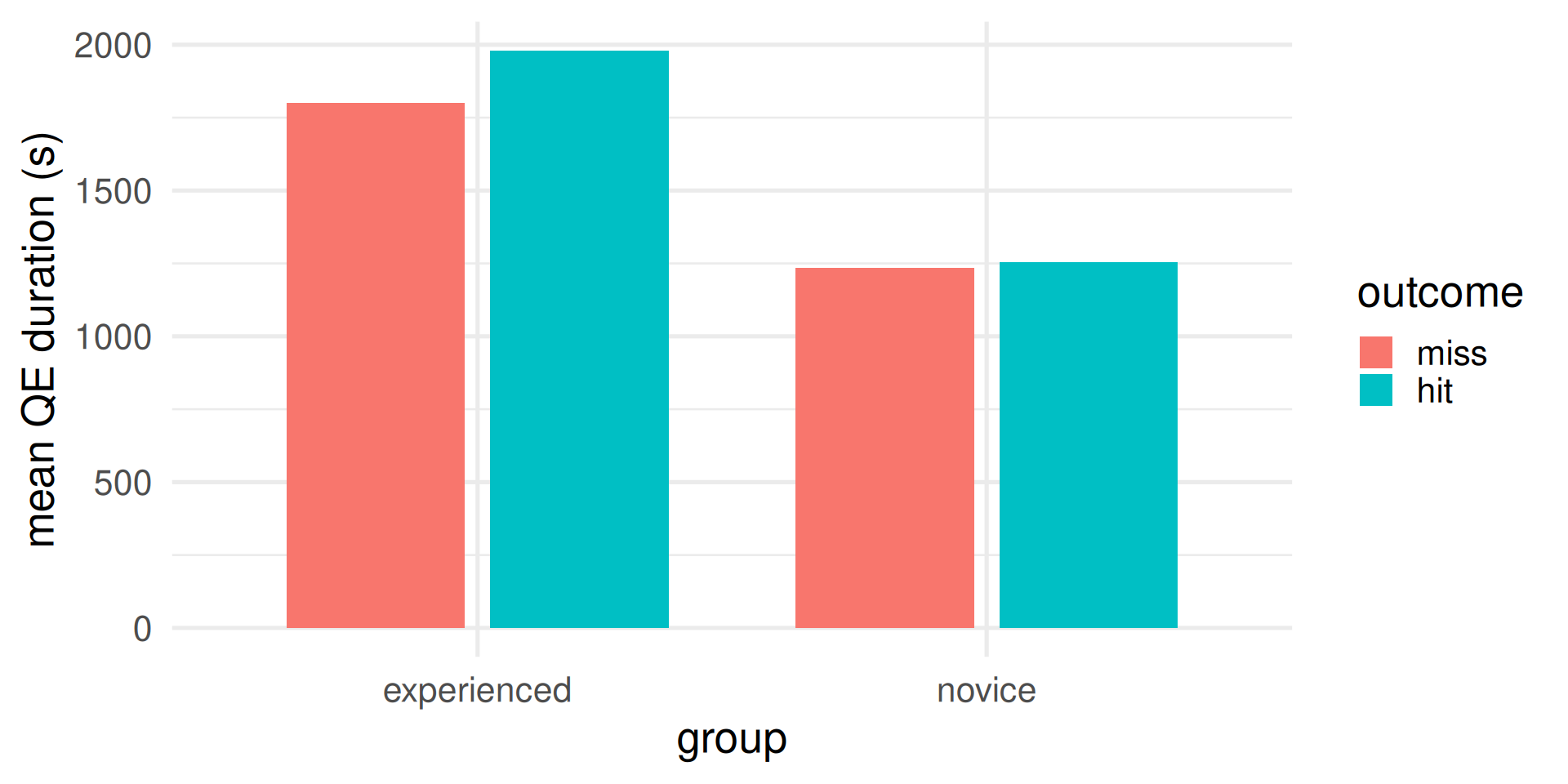
  • Experienced golfers showed longer QE durations than novices

Wilson et al. (2006)

Key methodology:

  • N = 24 university students
    • Median split into low and high trait anxiety
  • Task: simulated rally driving, under two conditions
    • practice (designed to induce lower state anxiety)
    • competition (designed to induce higher state anxiety)
  • Measures:
    • Trait and state anxiety (through questionnaires)
    • Effort mobilized (through questionnaire)
    • Performance (time to complete the race)
    • Effort
      • through questionnaire
      • pupil diameter (larger pupil = more effort)

Main results:

  • for both groups, state anxiety increased from practice to competition.

  • the high-trait anxiety group showed greater state anxiety.

  • Pupil diameter increased from practice to competition for both groups, being also larger for high-trait anxiety group

  • Self-report effort showed similar results, with the practice-to-competition increase much larger in the high-trait anxiety group.

  • No group difference in performance during practice

  • Performance decreased from practice to competition

  • Performance drop was larger for the high-trait anxiety group

Interpretation:

  • There were enough spare resources in working memory to complete the driving task when worry (state anxiety) used a small amount of resources.

  • Worry (state anxiety) occupied more resources in competition, especially for the high-trait anxiety group.

  • The high-trait anxiety group mobilized more resources, increasing their working memory, but the extra resources were not enough to maintain as good performance.

  • These findings support Processing Efficiency Theory

Part 2 of 2

Agenda

  • Brief recap of Procesing Efficiency Theory
  • Brief review of executive functions and revisiting Alan Baddeley’s model of working memory
  • Attentional Control Theory
  • Gaze training
  • Cognitive training
  • Mixture of theory, empirical research, and intuition

Very brief recap of Processing Efficiency Theory

People who experience greater cognitive anxiety (worry) perform worse than those who experience less. But this is not always the case… why?

  • There is not enough space in the working memory to process everything
  • Our attention selects information to be processed
  • Working memory and attention are not unitary concepts
  • Cognitive anxiety (worry) does not necessarily reduce performance
  • Effort can counteract the impairment at the expense of processing efficiency
  • Cognitive anxiety (worry) reduces processing efficiency

Executive functions

Alan Baddeley’s initial model of Working Memory was later expanded to include at-the-time improved understanding of executive functions.

A central executive B phonological loop A->B C visuospatial sketchpad A->C

A central executive D inhibition A->D E shifting A->E F updating A->F

Inhibition = Ability to resist to the processing task irrelevant information (i.e., resisting distractions)

Shifting = Ability to move focus towards the task relevant information (i.e., concentrating)

Updating = Ability to monitor and process information in working memory

Greater specificity on the central executive component of working memory and additional empirical evidence led to the development of Processing Efficiency Theory into Attentional Control Theory

Attentional Control Theory

Attentional Control Theory is defined by six hypotheses / predictions


Michael Eysenck

A ACT hypotheses B processing efficiency A->B C task demands A->C D attentional control A->D E inhibition A->E F shifting A->F G updating A->G

ACT hypothesis 1: processing efficiency

Cognitive anxiety impairs processing efficiency more than it impairs performance.

Worry (in blue) occupies resources in Working Memory. But there are enough resources to complete the task (in yellow).

ACT hypothesis 1: processing efficiency

Cognitive anxiety impairs processing efficiency more than it impairs performance.

Worry (in blue) takes resources away from the task (in yellow). Performance is impaired.

ACT hypothesis 1: processing efficiency

Cognitive anxiety impairs processing efficiency more than it impairs performance.

Overall resources (in white) are temporarily increased through greater effort. Performance of the task (yellow) is not impaired despite the large worry (blue). Efficiency decreases.

ACT hypothesis 2: task demands

The more difficult the task, the higher the chances of decreased efficiency

If the task is easy (i.e., it requires not many Working Memory resources), the effects of worry on efficiency are not visible (no need to put extra effort).

ACT hypothesis 2: task demands

The more difficult the task, the higher the chances of decreased efficiency

It is when the task is hard (i.e., it requires many Working Memory resources), that the effects of worry on efficiency are more likely to be visible (there is need to put extra effort).

ACT hypothesis 3: attentional control

Cognitive anxiety disrupts attentional control

A scale analogy:

⚖️

goal-directed (i.e., concentration) and stimulus-driven (i.e., distraction) types of orienting compete for which one is the main driver of attention/selection (i.e., what to focus on)

Attentional control = ability to maintain a goal-directed (endogenous) attentional orienting (concentration), while suppressing stimulus-driven (exogenous) attentional orienting (distraction)

The issue when performing under pressure:

GOAL-DIRECTED STIMULUS-DRIVEN

You lose focus on the task and become distracted by non-task related information.

The objective of performing under pressure intervention:

GOAL-DIRECTED
STIMULUS-DRIVEN

You shield from distractions and maintain focus on task-related information.

ACT hypothesis 4: inhibition

How is attentional control disrupted (hypothesis 3) under elevated cognitive anxiety? Through impaired inhibition

  • Impaired inhibition enhances the stimulus-driven path to attentional orienting
  • One becomes unable to block out irrelevant information
  • Potential distractions (non-task related activity) intrude in one’s attention

ACT hypothesis 5: shifting

How is attentional control disrupted (hypothesis 3) under elevated cognitive anxiety? Through impaired shifting

  • Impaired shifting decreases the goal-directed path to attentional orienting
  • One becomes unable to focus on the relevant information
  • Potential important information (task related activity) are not in one’s focus

ACT hypothesis 6: updating

How is attentional control disrupted (hypothesis 3) under elevated cognitive anxiety? Through impaired shifting

  • When the Working Memory is overloaded, it loses the ability to update and monitor information
  • One fails to keep track of changing task demands
  • Processing becomes less flexible and adaptive

Wilson et al. (2009)

Key idea:

  • Quiet Eye duration as measure of attentional control
  • Does anxiety impair QE durations?

Key methodology:

  • N = 10 university students (basketball players)
  • Task: free throws until 10 hits and 10 misses
  • Conditions:
    • Control (low pressure)
    • Experimental (high pressure, competition and financial incentive)
  • Measures:
    • State anxiety, through questionnaire
    • Quiet Eye duration, through eye tracking

Key results:
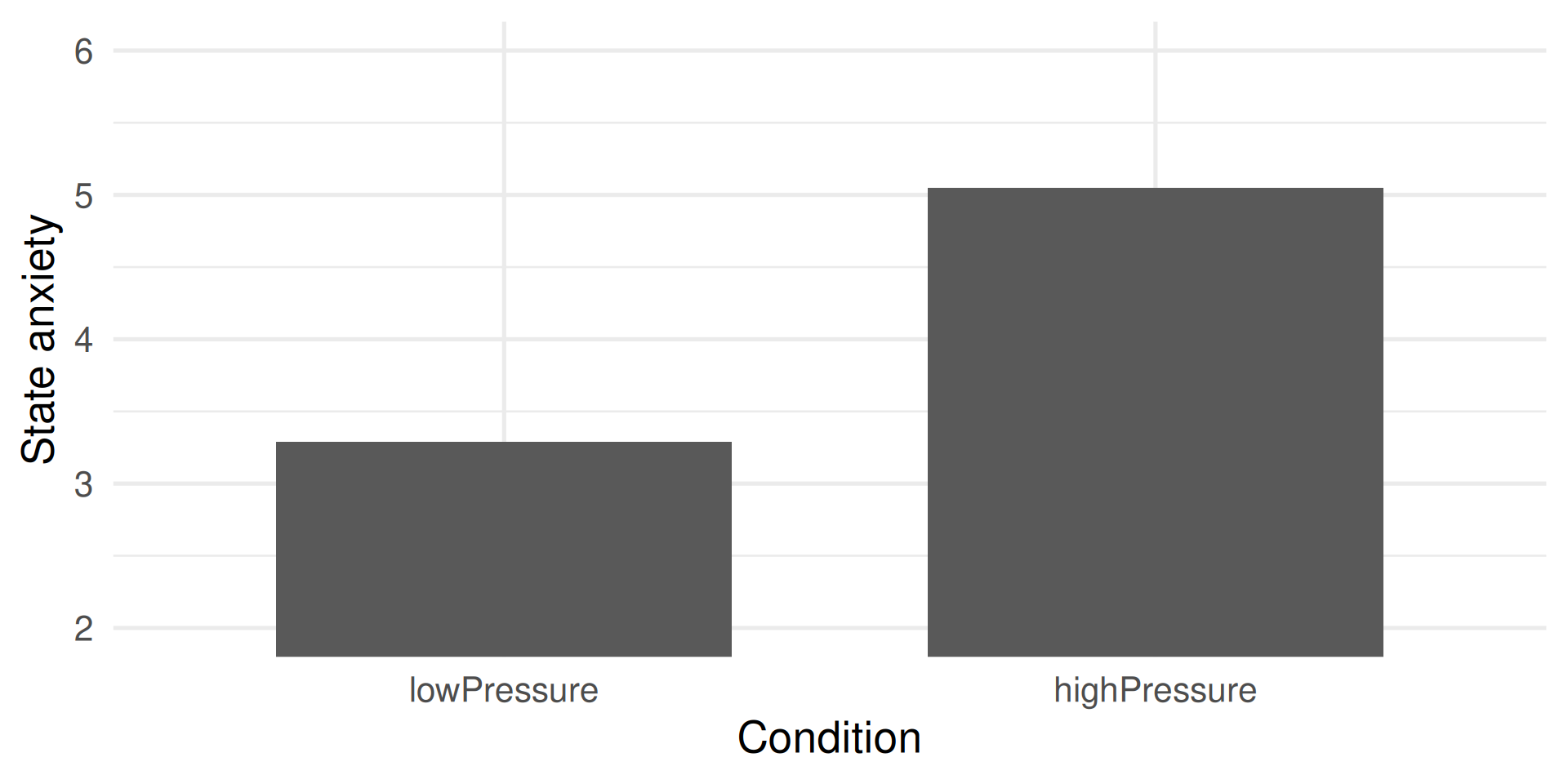
State anxiety was larger in the experimental condition.
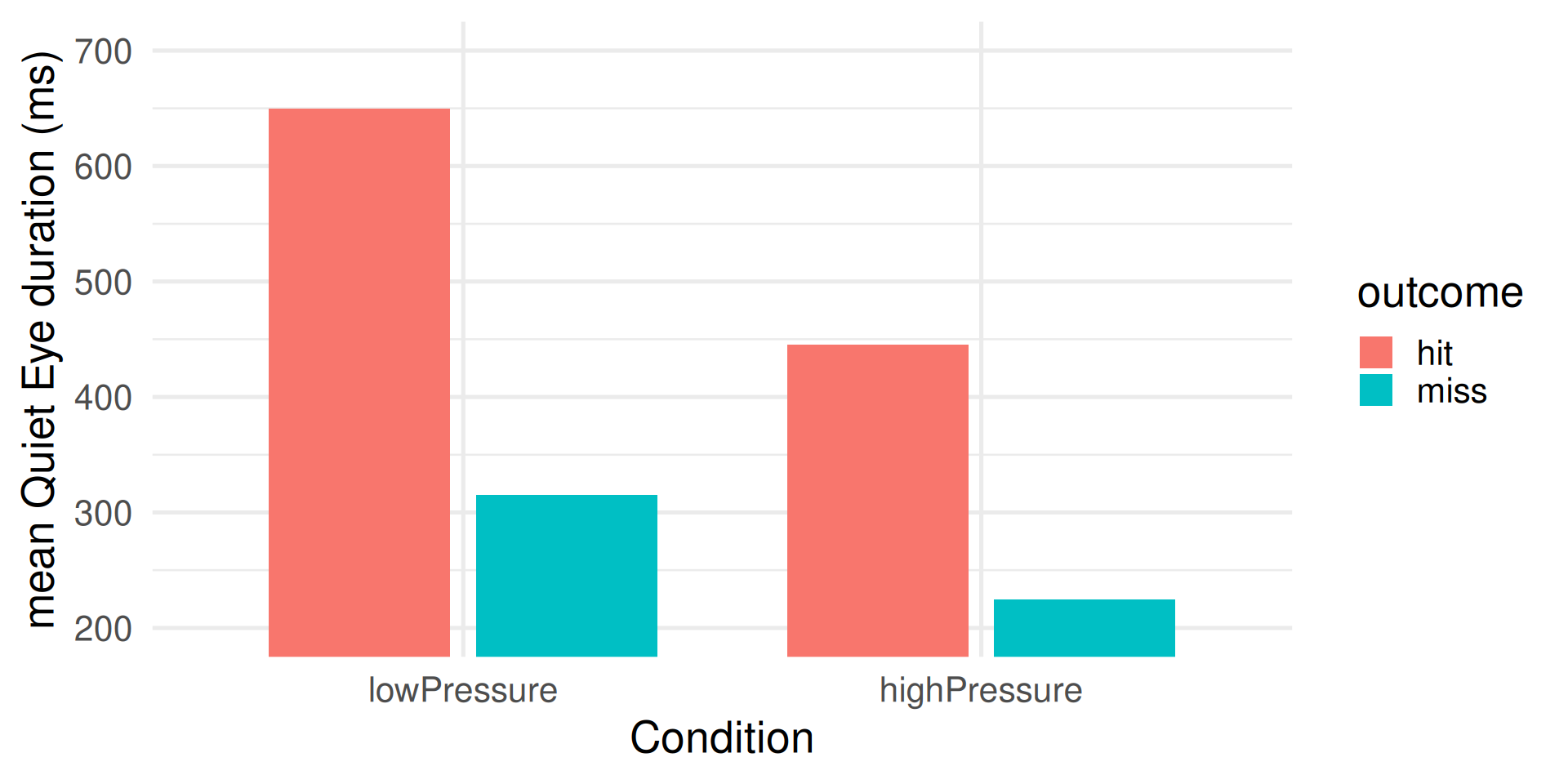
Effect of outcome: Shorter Quiet Eye duration for missed throws.

Effect of pressure: Shorter Quiet Eye duration under greater pressure.

Some evidence that attentional control is impaired under elevated state anxiety

Interventions

A ACT-compatible interventions B gaze training A->B C cognitive training A->C

Attentional control can be improved through Gaze Training and Cognitive Training.

These interventions are not specific but compatible with Attentional Control Theory.

We will review what they are, what ACT-specific mechanisms they address (supposedly), and some empirical evidence supporting them.

Specificity of mechanisms
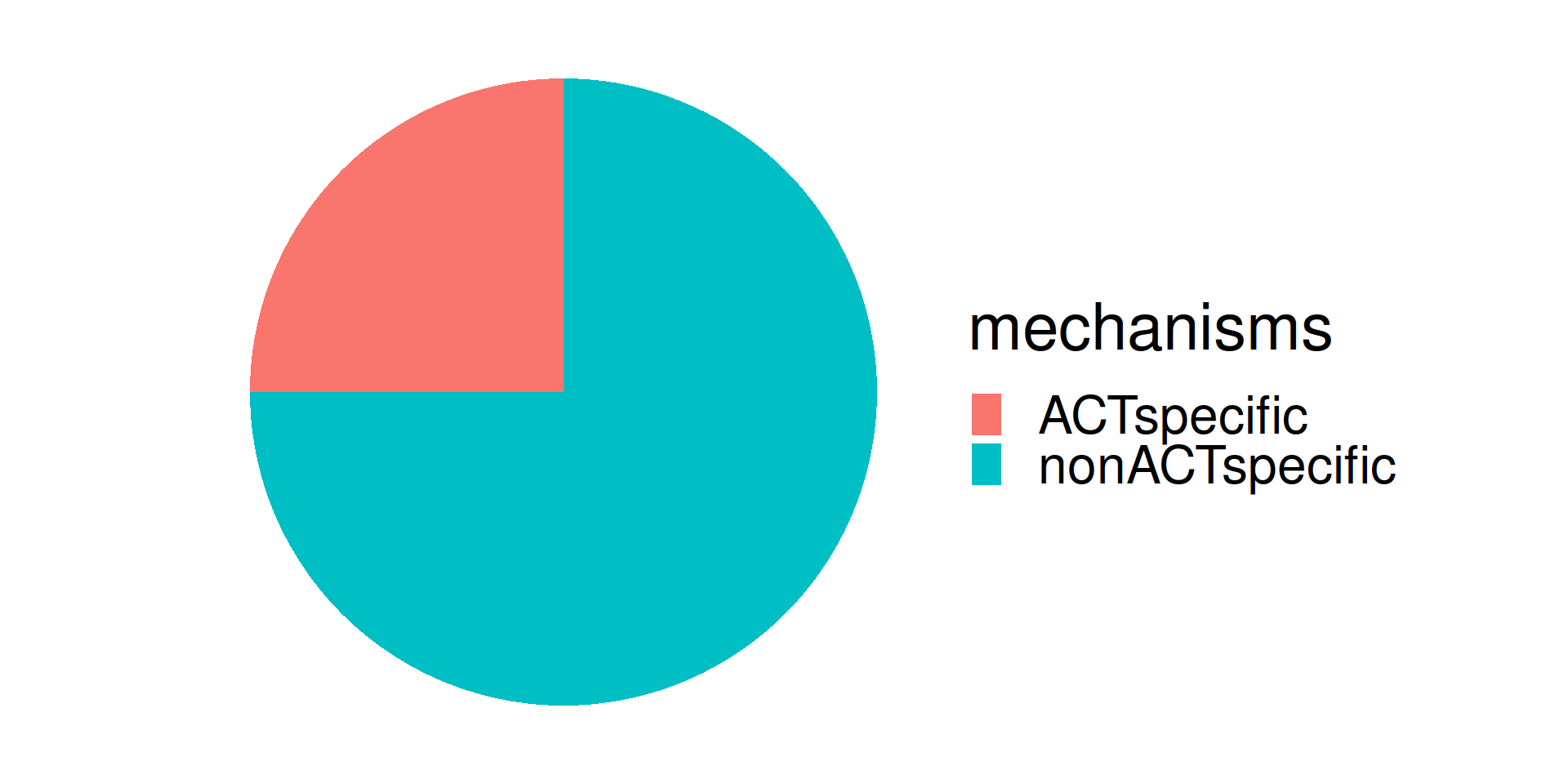
Several mechanisms have been proposed to explain why gaze trainign and cognitive training enhance performance under stress. Only some of those mechanisms are compatible with Attentional Control Theory. We will review only those.

Interventions: Gaze training

What is it: Training to exhibit a longer quiet eye duration, specifically under greater cognitive anxiety (worry).


ACT-specific mechanisms that it fixes:

  • Quiet Eye duration as index of dominance of goal-directed orienting (more concentration) over stimulus-driven orienting (more distraction)
  • Training for a longer Quiet Eye duration allows greater goal-directed and less stimulus-driven orienting

Caveats to consider for the success of training:

  • Most experts already have long Quiet Eye durations, at least in low-pressure situations
  • Not for all sports it is easy to identify where the visual focus should be and for how long

Interventions: Cognitive training

What is it: Training to increase your working memory capacity (i.e., the desk from the analogy).


ACT-specific mechanisms that it fixes:

  • Anxiety (worry) occupies resources from working memory, conflicting with resources that should be dedicated to task-related processing
  • A permanently larger working memory capacity would increase the chances that, despite worry taking resources, there would be enough left for processing task-related information.

Caveats to consider for the success of training:

  • Tranferrability to real-world tasks

Vine & Wilson (2010)

First Quiet Eye training study

Key methodology:

  • N = 14 university students, minimal golf experience
    • control goup: technical training
    • experimental group: technical and Quiet Eye training
  • Design: longitudinal (i.e., over time)
  • Task: straight putts

Procedure:

cluster_group1 post-test A pre-test B1 Control training (8 sessions) A->B1 B2 Experimental training (8 sessions) A->B2 C retention 1 B1->C B2->C D transfer (high pressure) C->D E retention 2 D->E

Training protocol instructions

Technical instructions:

  • Stand with legs hip width apart and keep your head still.
  • Maintain relaxation of shoulders and arms.
  • Keep the putter head square to the ball.
  • Perform a pendulum-like swing and accelerate through the ball.
  • Maintain a still head after contact.

Quiet Eye training instructions

  • Assume stance and ensure that gaze is on the back of the ball.
  • Fixate the hole. (Fixation should be made no more than three times.)
  • Your final fixation should be on the back of the ball and for not longer than 2-3 seconds.
  • No gaze should be directed to the club head or shaft during the putting action.
  • Your fixation should remain steady for 200-300 ns after contact with the ball.

Key results:
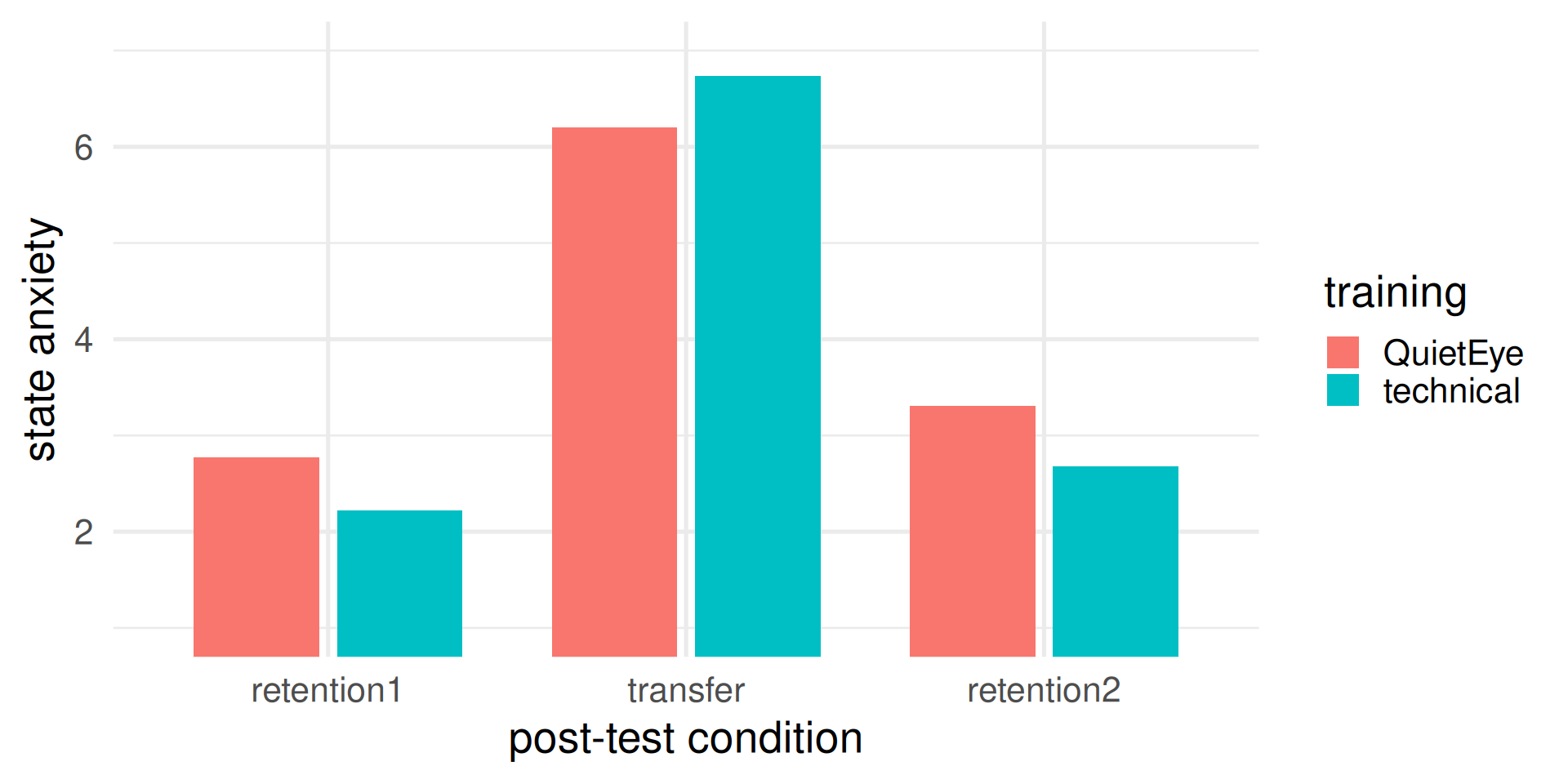
The training did not have an effect on state anxiety. The training did not distinguish people’s anxiety reaction to competitive pressure.
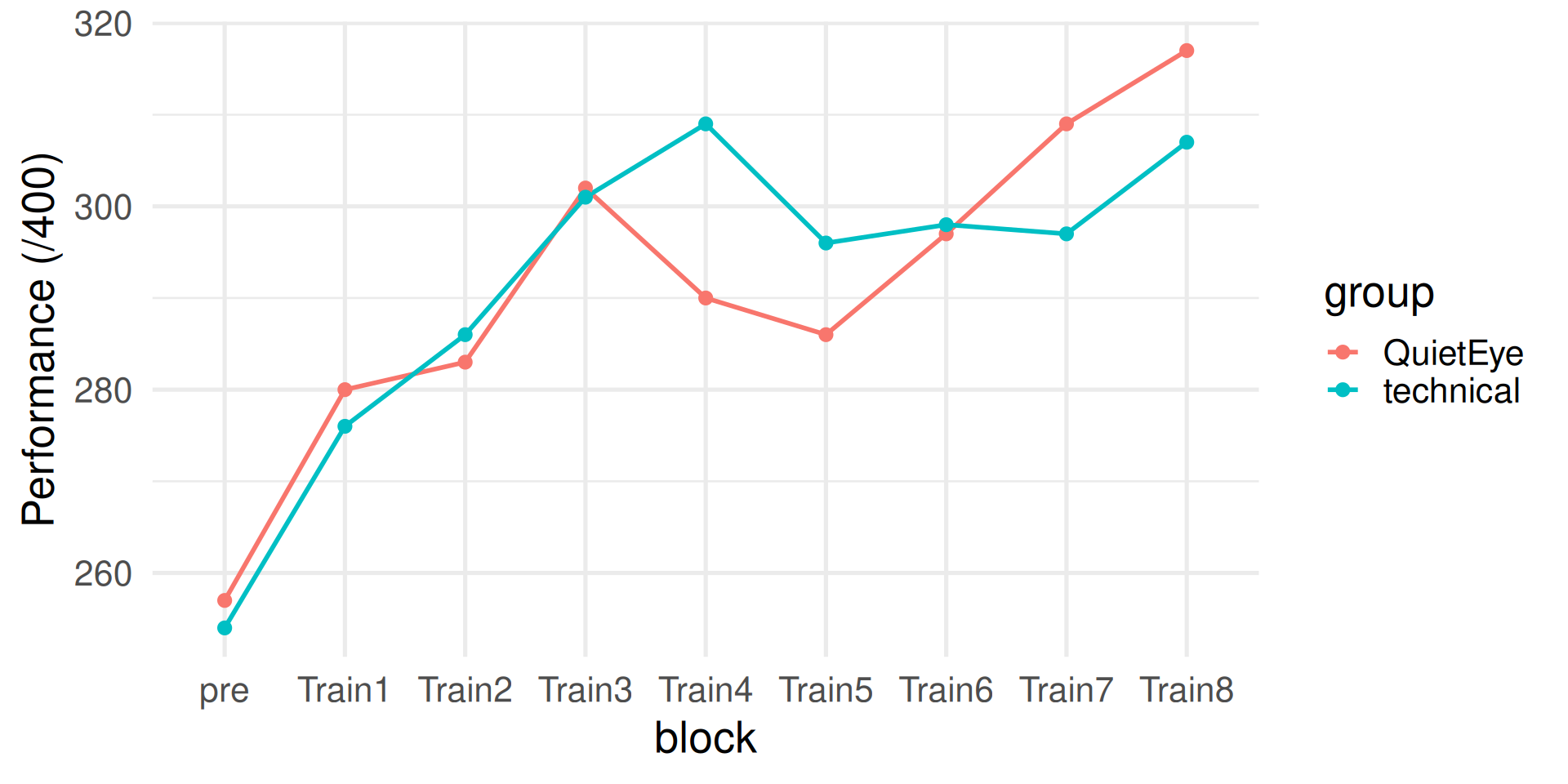
No performance differences at pre-test (before training).

Performance overall improving for both groups.

No obvious performance advantage on one group over the other.
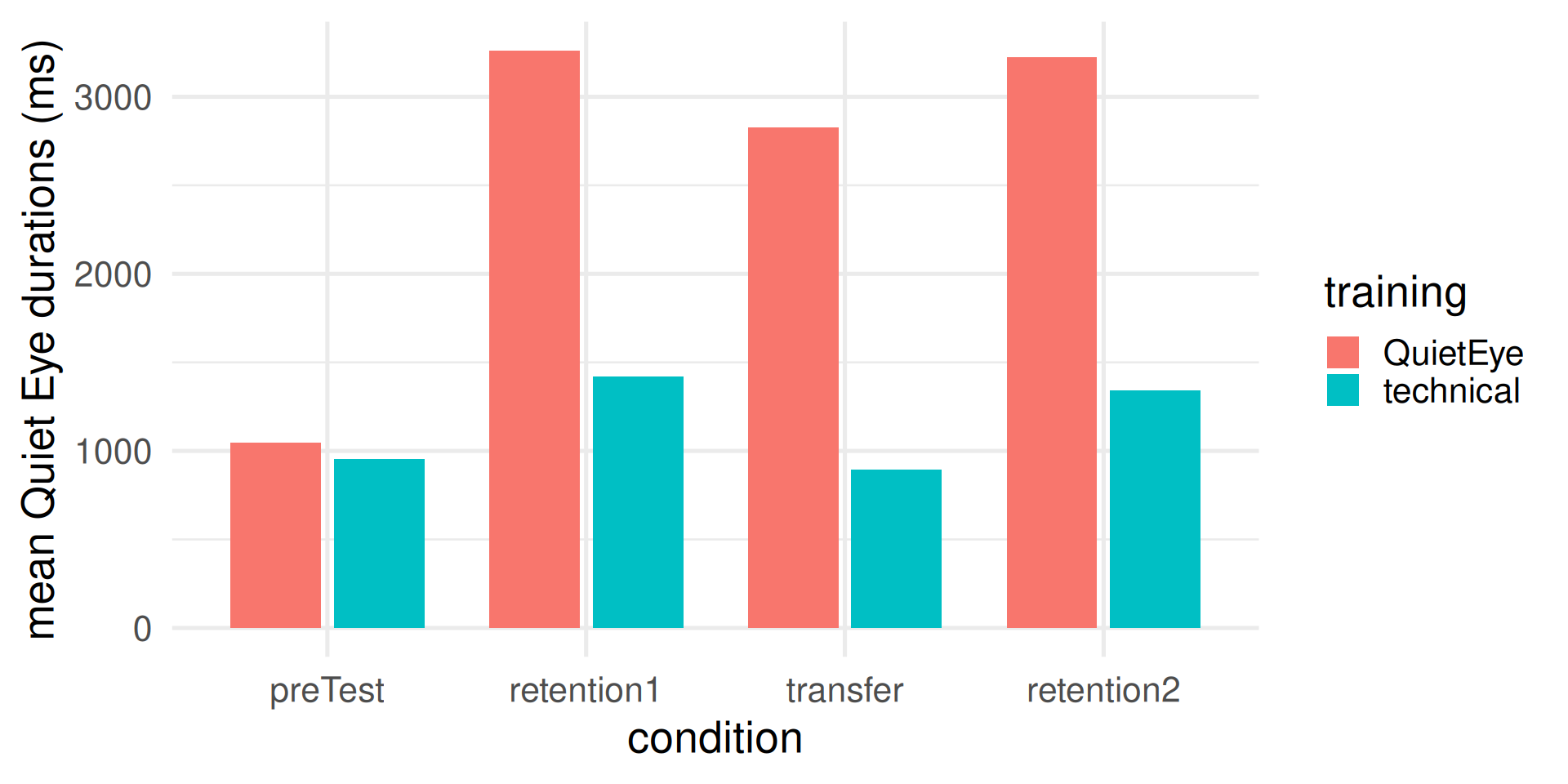
Quiet Eye durations were as expected:

  • equal between groups at pre-test
  • longer for the QE group, at the post-tests
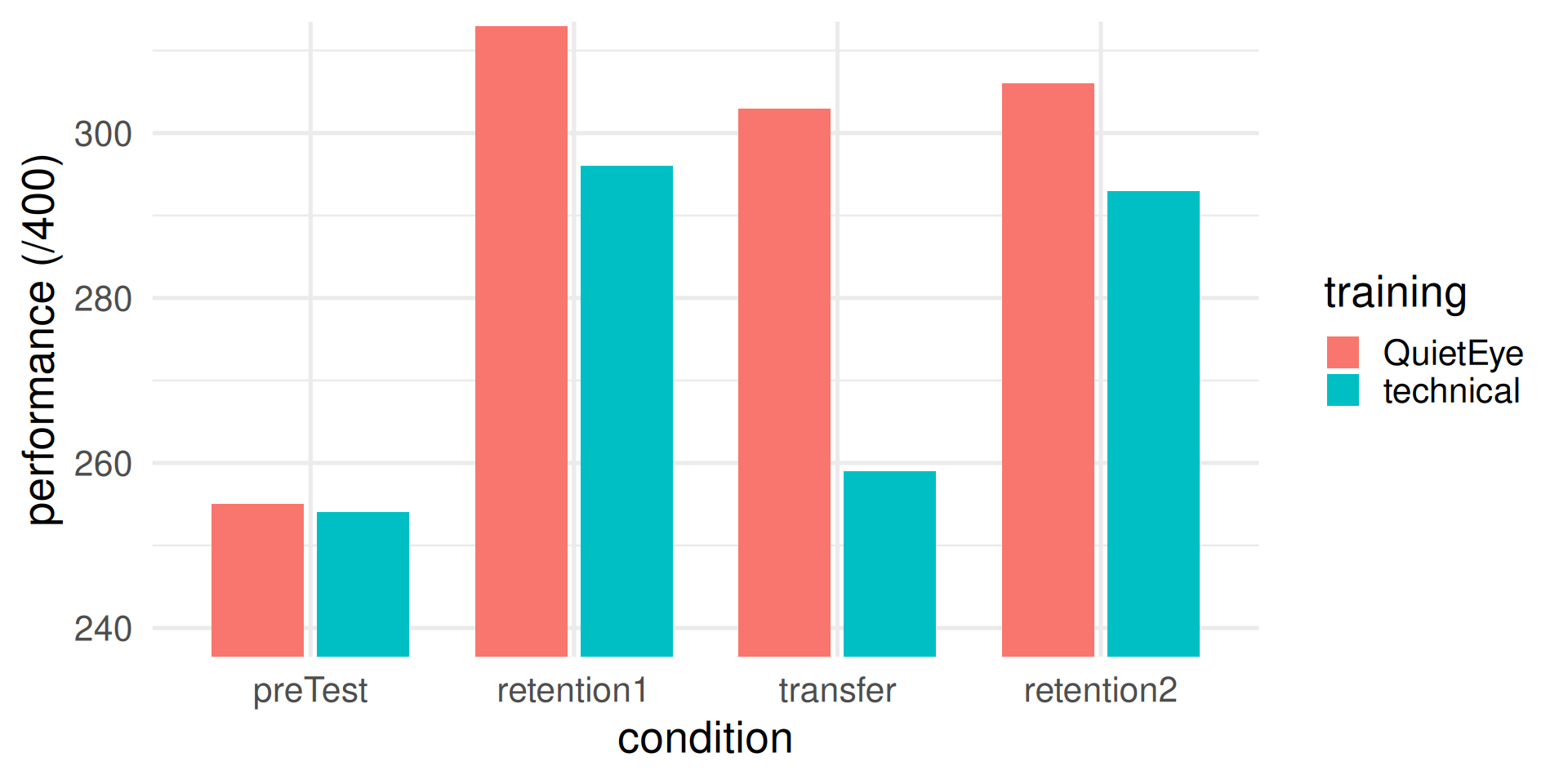
Performance was comparable across groups at all retention post-tests, except at transfer (high pressure performance), where the technical but not the Quiet Eye group showed a significant drop in performance

Sari et al. (2016)

Key methodology:

  • N = 26 university students, pre-screened through questionnaires for high trait anxiety and low attentional control
    • experimental group: adaptive cognitive trainining (adaptive dual n-back)
    • control group: low-load cognitive training (non-adaptive dual 1-back)
  • Design: longitudinal (i.e., over time)

Procedure:

A pre-test B1 Control group (15 sessions) A->B1 B2 Experimental group (15 sessions) A->B2 C post-test B1->C B2->C

  • Some pre and post-test measures:
    • attentional control through rest state electroencephalography (EEG)
    • Flanker task performance (Link to Flanker task), under anxiety-inducing conditions (loud and unpredictable noise bursts)

Training explanations:

  • visual n-back: one 3x3 grid is presented at the time with only once cell illuminated. Participants need to respon when the same grid was presented n trials before.
  • phonological n-back: one letter is pronounced at the time. Participants need to respon when the same letter was presented n trials before. (Link to classic visual letter n-back)
  • dual n-back: visual and phonological stimuli are presented simultaneously. Trials can match visually (press a key), phonologically (press another key), or both (press both keys)
  • adaptive dual n-back: the number n increased or decreased at the next block depending on accuracy at the previous block. Consult the paper for a figure of the stimuli
  • Schedule: 15 sessions in 21 days

Some key results

  • the adaptive group reached high levels of complexity (large n in b-back)
  • The adaptive group showed better Flanker task performance under conditions of elevated state anxiety
  • The adaptive group showed larger values of EEG indices associated with better attentional control
  • Cognitive training improved attentional control under pressure / resilience of attentional control to pressure

Ducrocq et al. (2017)

Key methodology:

  • Similar to that of Sari et al. (2016) but in a sport task (tennis)
  • N = 30 participants from tennis club
    • experimental group: adaptive dual n-back
    • control group: non-adaptive dual 1-back
  • Some pre- and post-test measures:
    • performance at change detection task
    • tennis volley task performance and Quiet Eye duration, under lower and higher pressure

Some key results

  • The experimental group reached performed better than the control group at the change detection task
  • The experimetal group performed better at the higher pressure, whereas no changes in the control group
  • The experiemntal group showed later Quiet Eye period offset than the control group

Optional: Some thoughts

Which model of performing under pressure is right?

Attentional control

Reinvestment

Challenge and threat appraisal

Psychomotor efficiency

Constrained action

Ironic processing

Etc.

No doubts these models will be refined again and again, and that’s the researcher’s job. For applied contexts, however, I encourage you to focus on the utility of a model (in explaining a phenomenon or achieving practical impact).

George E. P. Box

George E. P. Box Read more.

“All models are wrong, but some are useful.

Optional material from Rob Gray’s perception and action podcast

Performing and choking under pressure


Interview with Sam Vine, Quiet Eye, Pressure, VR training


Choking under pressure revisited: critiques


Choking under pressure revisited: integrative theories


Sports Science Shorts: Choking under pressure Q&A


Interview with Denise Hill, choking under pressure

Source: The Perception & Action Podcast by Rob Gray