Working memory has limited capacity (feature #1)
Think of working memory as the set of resources for temporarily holding and manipulating information.
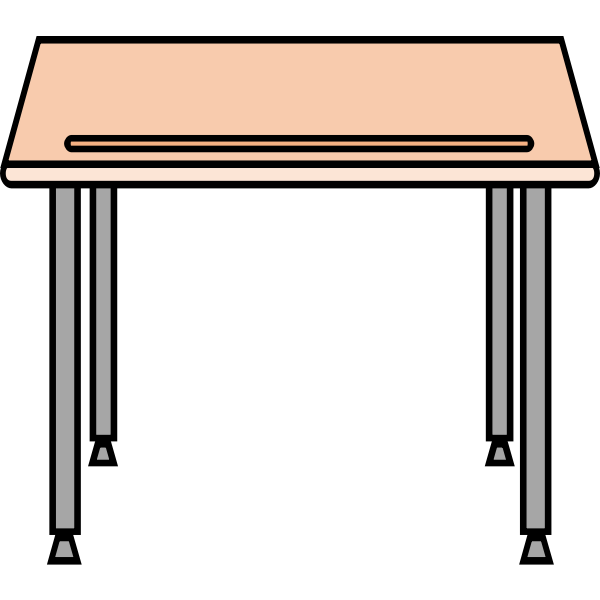
Analogy used often: a working desk. There is enough space for the things you are working on right now, not much else…
Working memory’s multiple components (feature #2)

Alan BaddeleyThree different components handle storage of information (e.g., visuo-spatial, verbal-phonological) or manage access to that information.
“Cocktail party” scenario: demonstrating goal-directed (endogenous) and stimulus-driven (exogenous) attentional orienting
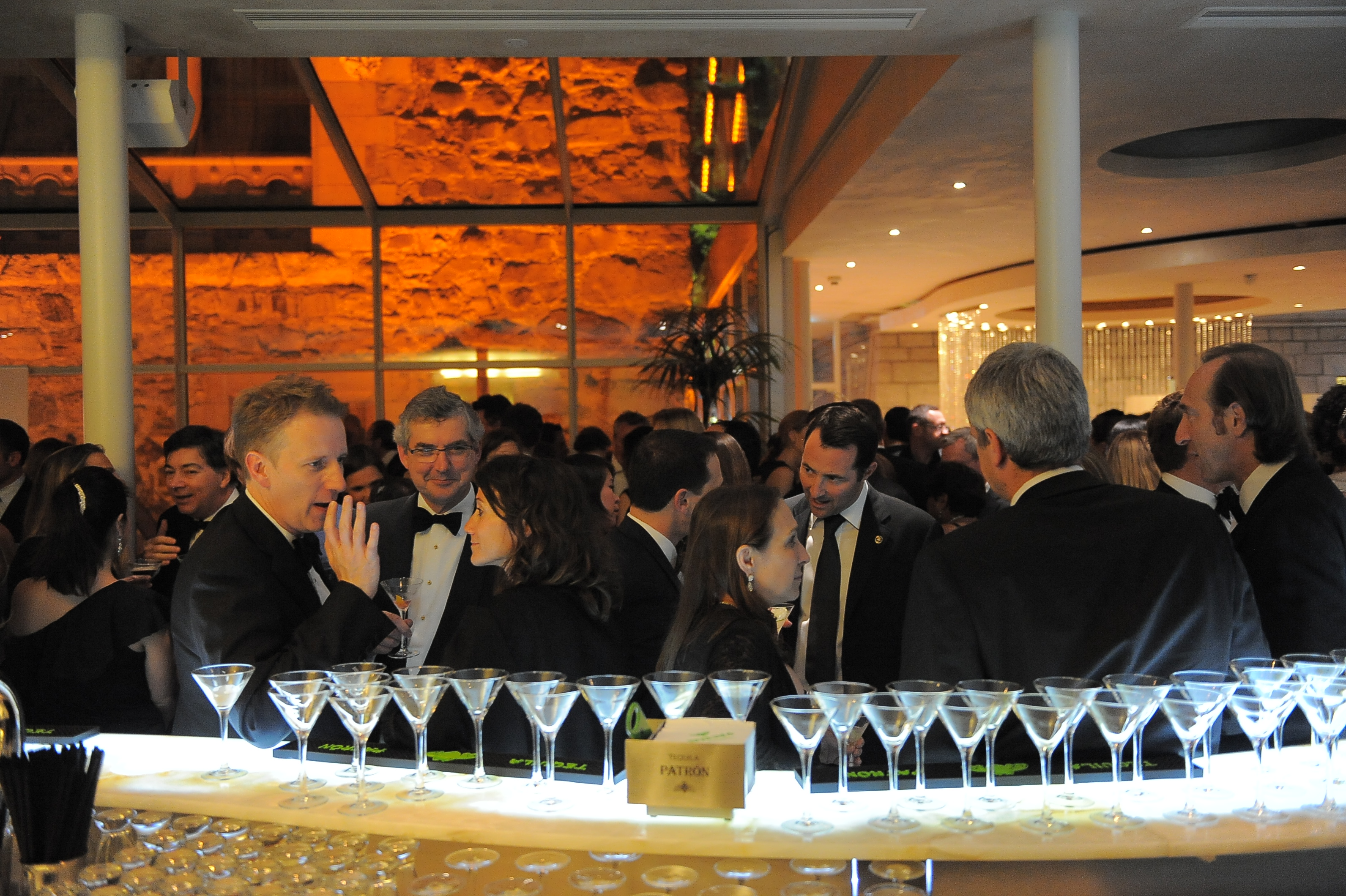
Designed to illustrate selective feature of attention at the preconscious level, but here merely a shortcut for me to illustrate goal-directed and stimulus-driven attention at play.
You are in a noisy place. You choose to attend to one speaker (goal-directed). Suddenly, your attention is captured (distracted) by a salient, personally relevant cue (like hearing your name from your back) (stimulus-driven).
Important: the extent of attentional control can be defined as the balance between goal-directed (concentration) and stimulus-driven (distraction) attention
What does anxiety do to attentional control?
Shapiro & Johnson (1987)
Study 1, key methodology
- N = 30 University students
- Task: Use one hand to classify central and peripheral target stimuli (perceptually difficult because the target stimuli were presented for a short duration)
- Participants needed to keep their eyes on a central fixation cross. A target stimulus could appear either centrally or in the periphery … or both: dual trial (i.e., two targets at the same time)
- Groups: arousal, non-arousal
- The other hand was for receiving electrical shocks every now and then, but only the lucky ones in the arousal group.
- Analyses: the researchers were interested in the participants’ choices in the dual trials.
Study 1, main results
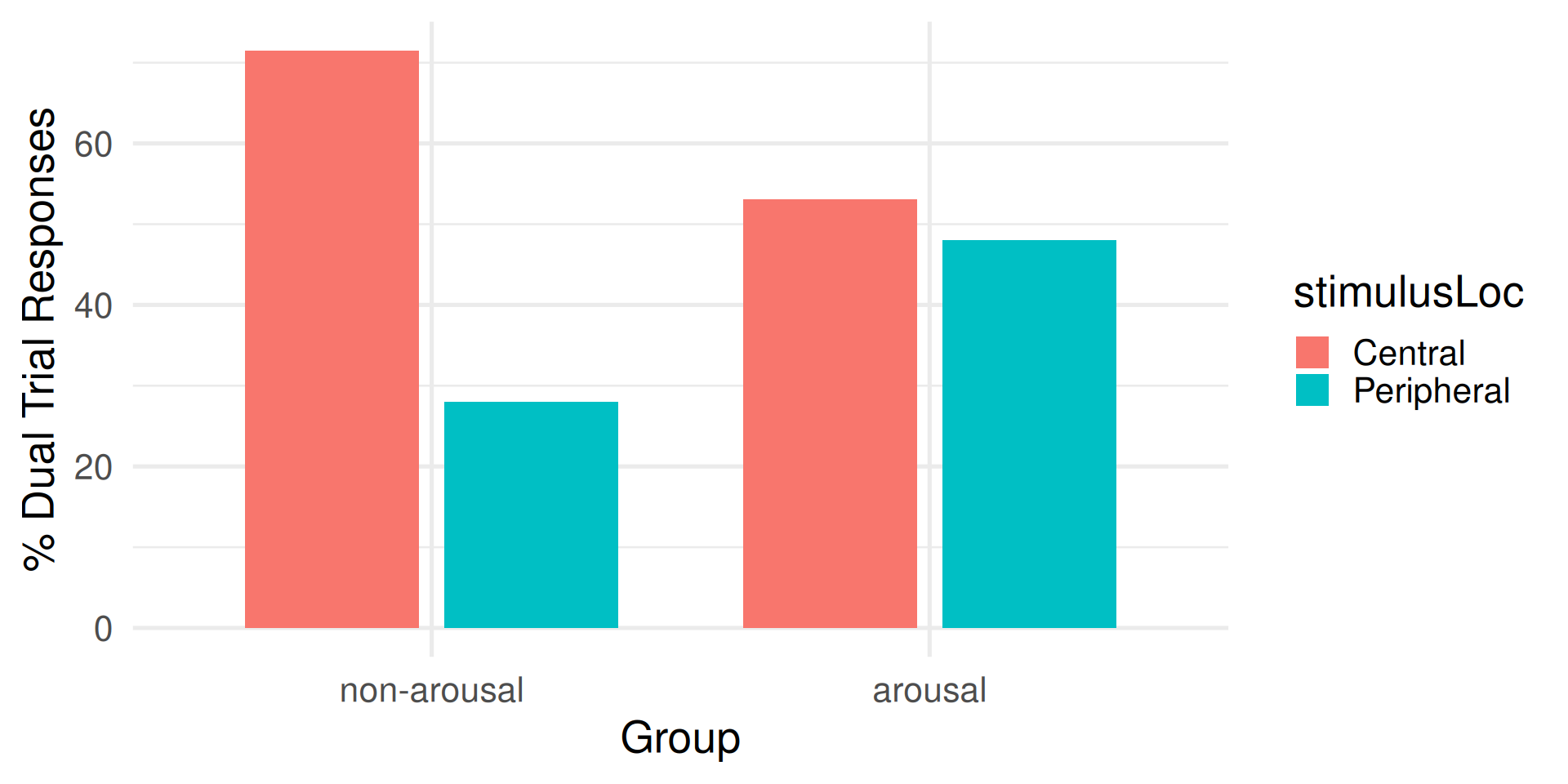
For the non-arousal group, dominance of central stimulus
For the arousal group, no dominance. Arousal countered the dominance of the central stimulus.
Shapiro & Johnson (1987)
Study 2, key idea
They realized the central stimulus was more predictable (only one location) than the peripheral stimulus. In study 2, they used the same Method, but made the central location less predictable than in study 1.
Study 2, main results
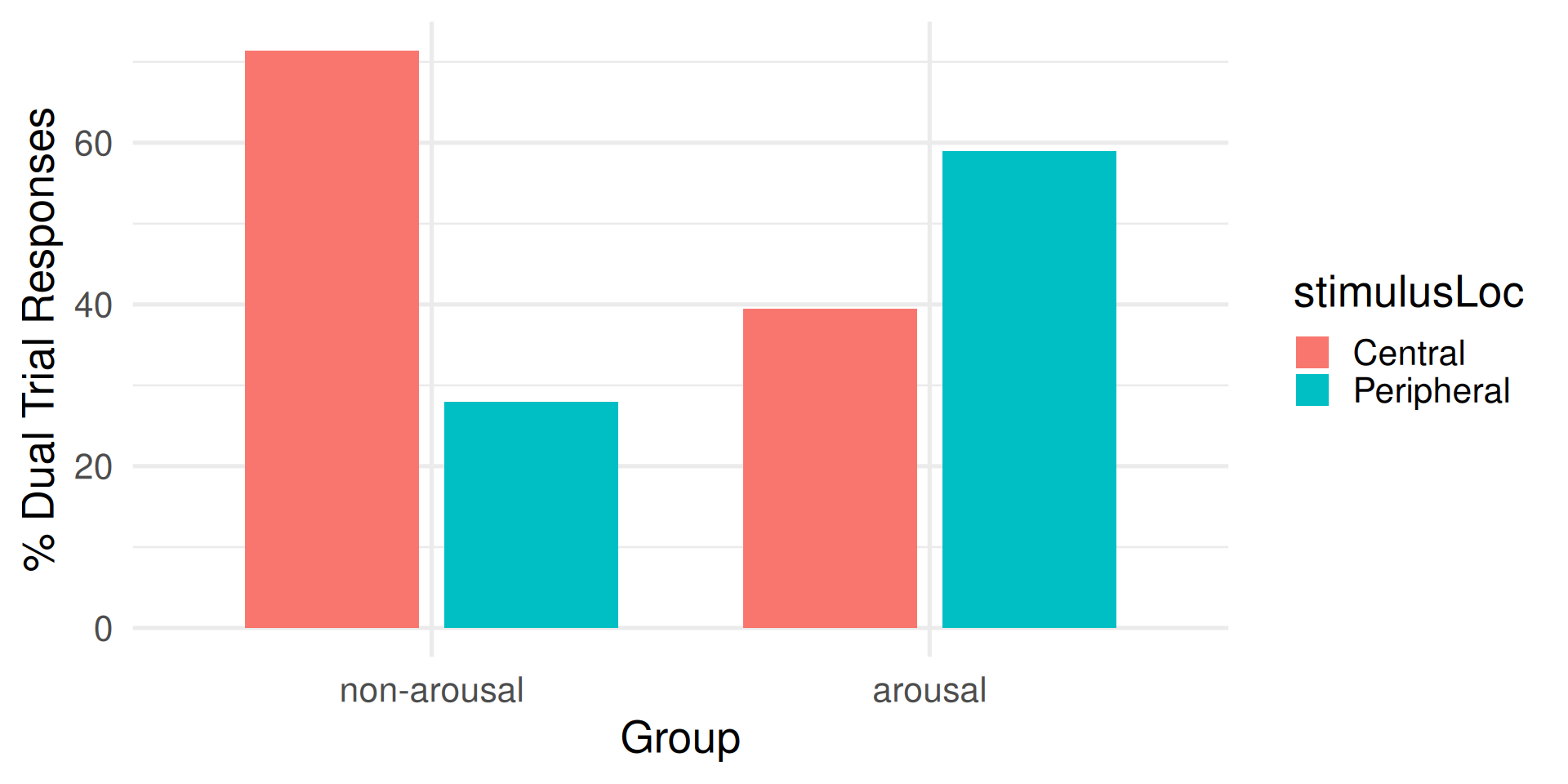
Arousal reversed the dominance, so that when a pair of central-peripheral targets were presented, the peripheral target became the dominant.
Lautenbach et al. (2016)
Key methodology:
- N = 40 athletes
- Task: emotional Stroop task
- A: negative sport related words (e.g., defeat, failure, rival)
- B: neutral sport related words (e.g., endurance, position, sideline)
- C: neutral non-sport related words (e.g., radio, lemon, computer)
Main results:
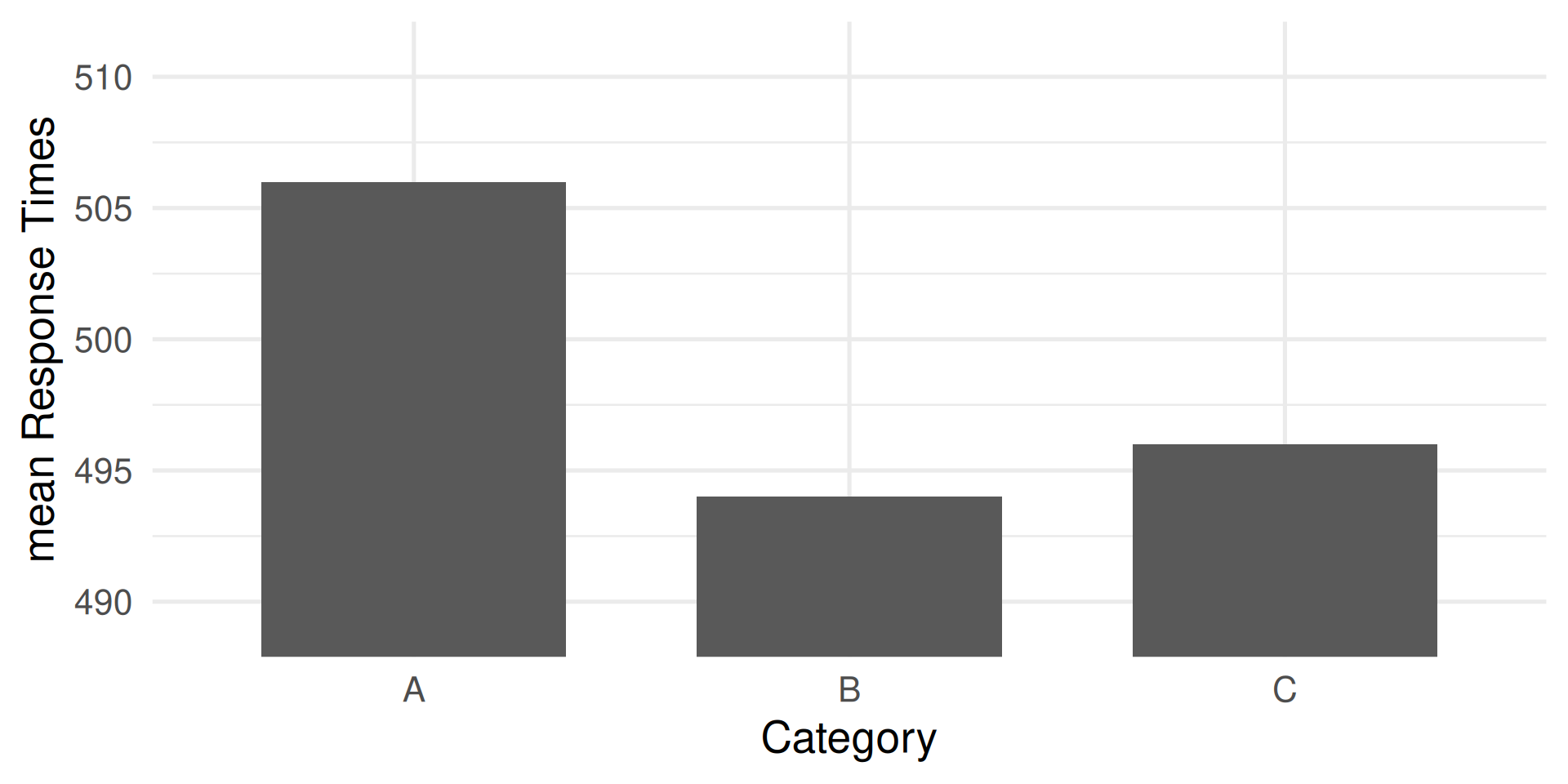
Significantly slower when responding to negative sport-related words.
Smith et al. (2001)
Key methodology:
- N = 12 volleyball players
- 6 low and 6 high in trait anxiety
- Task: Eigth volleyball games
- Measures:
- State anxiety (through questionnaire)
- Effort mobilized (through questionnaire)
- Performance (through video analyses)
- Analysis factors
- Group (low, high trait anxiety)
- set criticality
- low: 7 or more points of difference
- moderate: between 3 and 6 points of difference
- high: less than 2 points of difference
Predictions:
- State anxiety would be greater for more critical sets
- Effort would also be greater for more critical sets
- Performance would increase when more effort is mobilized
- but only for the low-trait anxiety group
Main results:
- High-trait anxiety groups experienced greater state anxiety
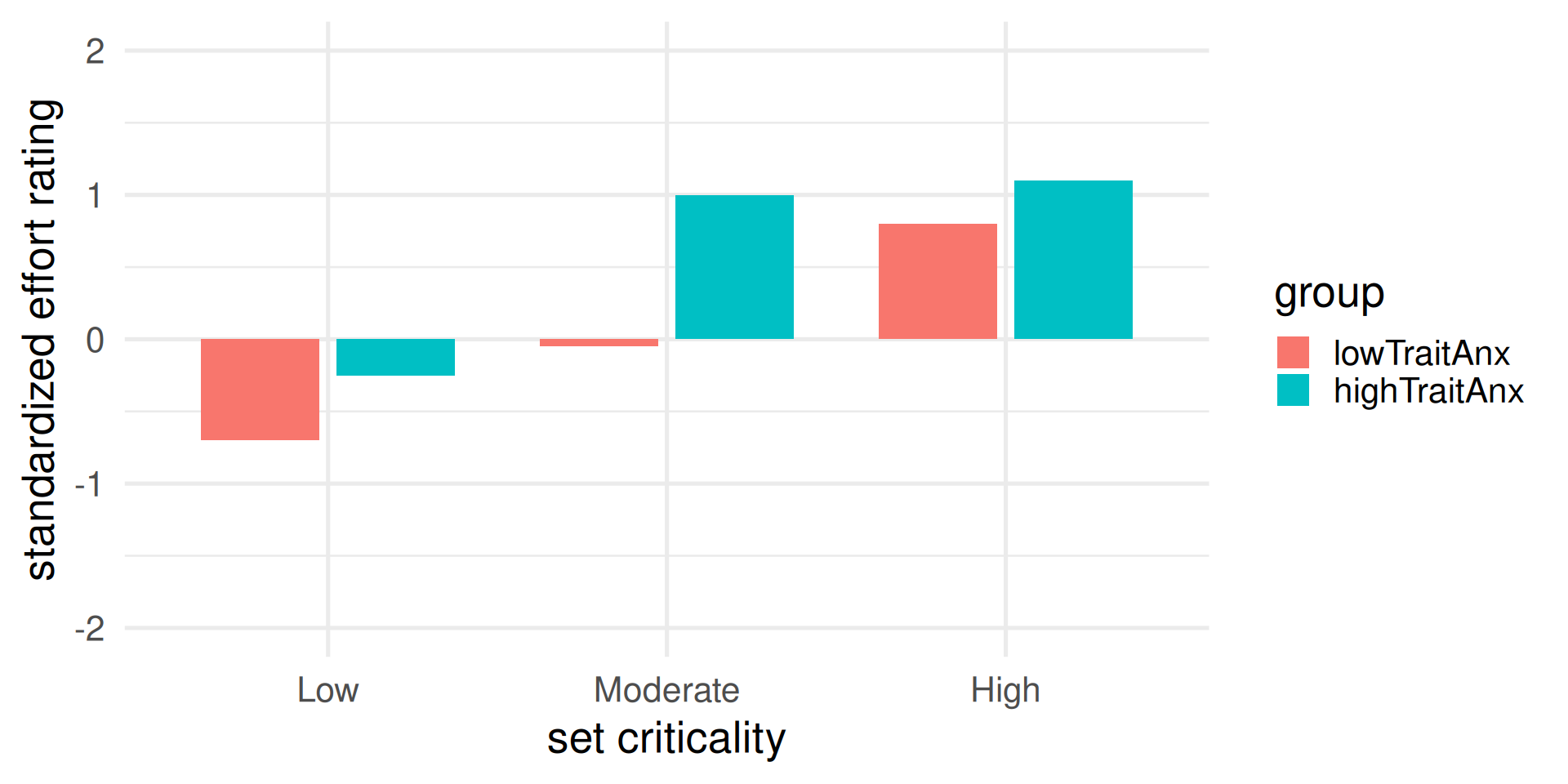
- Effort increased with set criticality
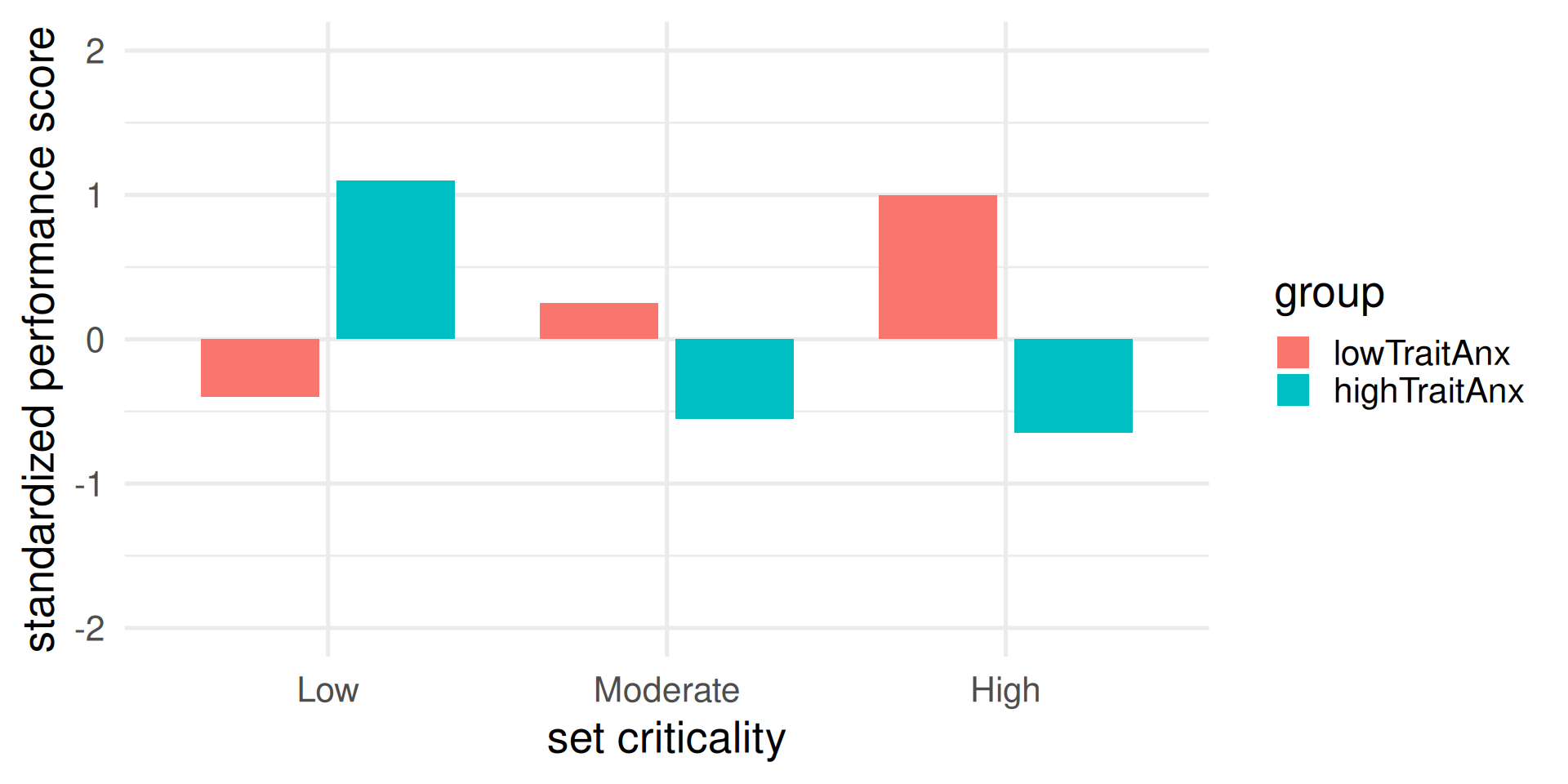
- Performance improved with set criticality for the low-trait anxiety group
- Performance declined with set criticality for the high-trait anxiety group
Interpretation: Performance and worry competed for resources. As worry (state anxiety) increased over set criticality, fewer and fewer resources were left to focus on the volleyball task. Some support for Processing Efficiency Theory
Visuospatial attention in target sports: the quiet eye
 Joan Vickers
“Quiet Eye” as much a phenomenon as a variable.
As a variable
- The QE is a duration of time, units of (milli)seconds
- Eyes on the critical location or object (e.g., ball in golf putting)
- It starts before movement initiation (“QE onset”)
- It ends when the gaze deviates from the location or object of a certain amount (“QE offset”)
As a phenomenon
Extensive reports in literature that:
- experts have a longer QE than novices
- QE is longer for successful than unsuccessful performance
- it is trainable
Mechanisms / What happens during the QE that is beneficial to performance?
- Visual processing
- Postural-kinematic quiescence
- a few others…
Wilson & Pearcy (2009)
Key methodology:
- N = 6 participants
- Task: Golf putting on flat and sloped surfaces
- Measure:
- Performance
- Quiet Eye duration via eye tracking
Key result:
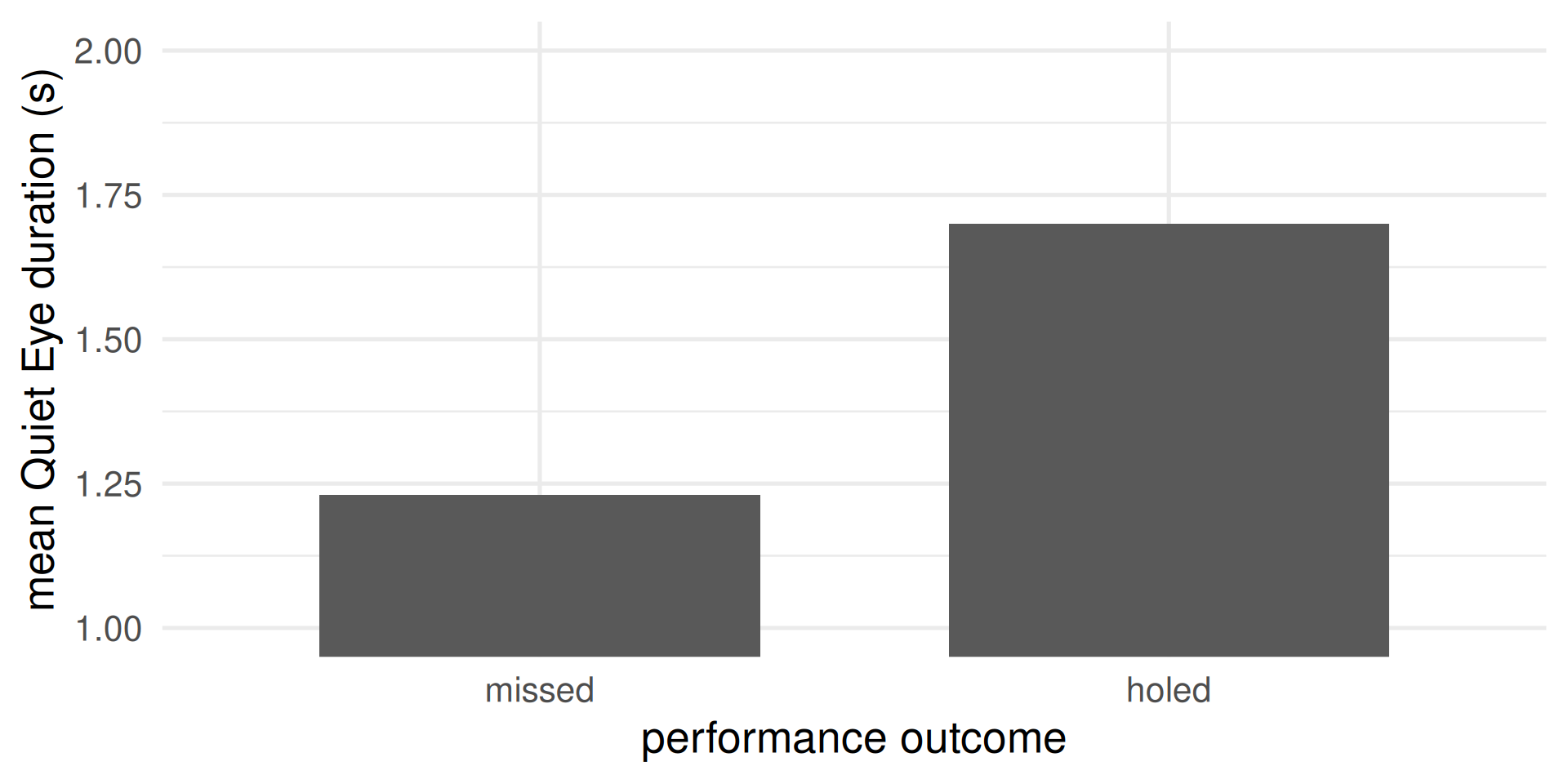
Significantly longer QE durations ahead of holed than missed putts.
Walters-Symons, Wilson, & Vine (2017)
Key methodology
- N = 18 experienced golfers
- N = 21 novice golfers
- Task: flat-surface golf putting
Key result
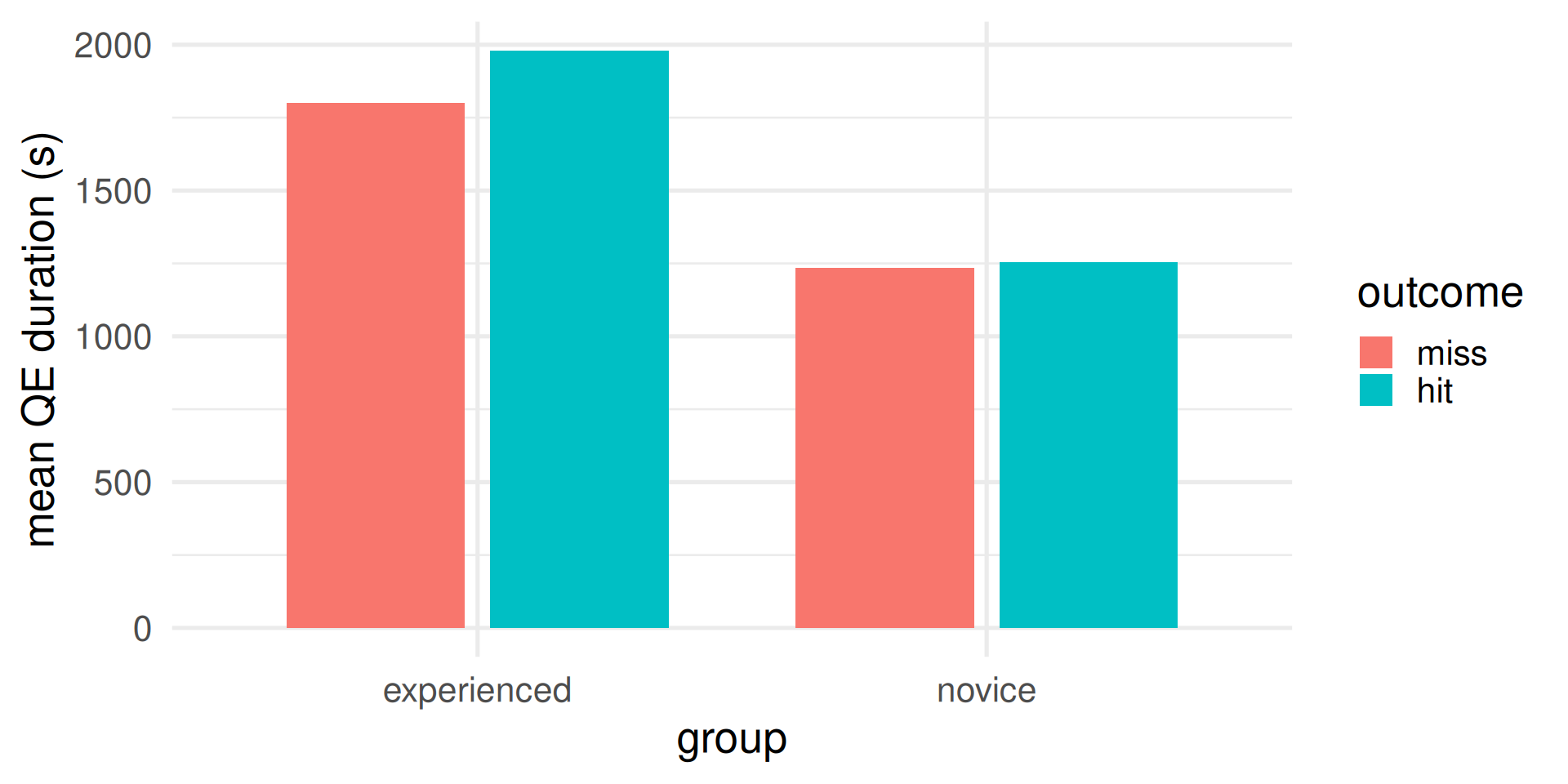
- Experienced golfers showed longer QE durations than novices
Wilson et al. (2009)
Key idea:
- Quiet Eye duration as measure of attentional control
- Does anxiety impair QE durations?
Key methodology:
- N = 10 university students (basketball players)
- Task: free throws until 10 hits and 10 misses
- Conditions:
- Control (low pressure)
- Experimental (high pressure, competition and financial incentive)
- Measures:
- State anxiety, through questionnaire
- Quiet Eye duration, through eye tracking
Key results:
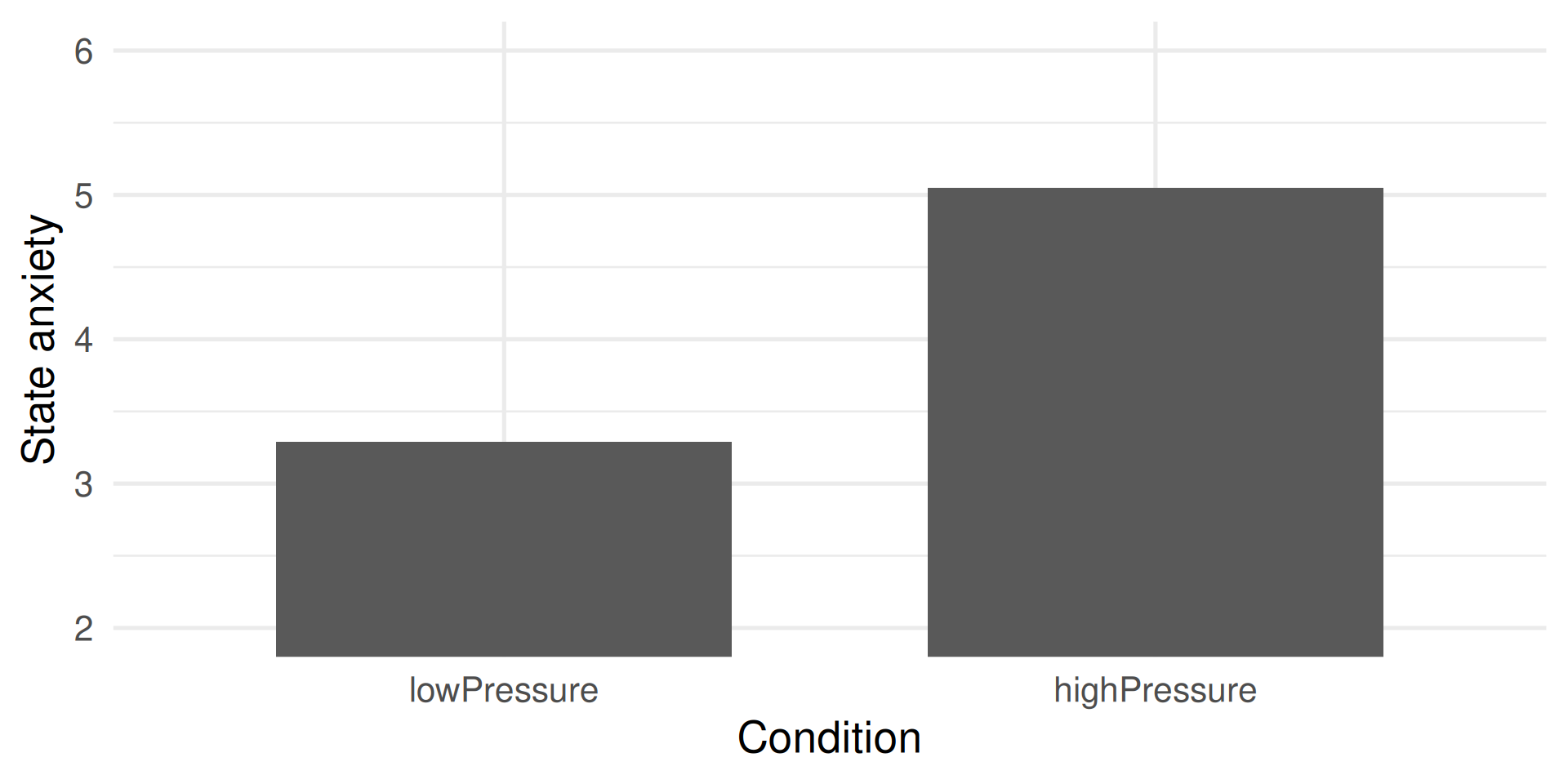
State anxiety was larger in the experimental condition.
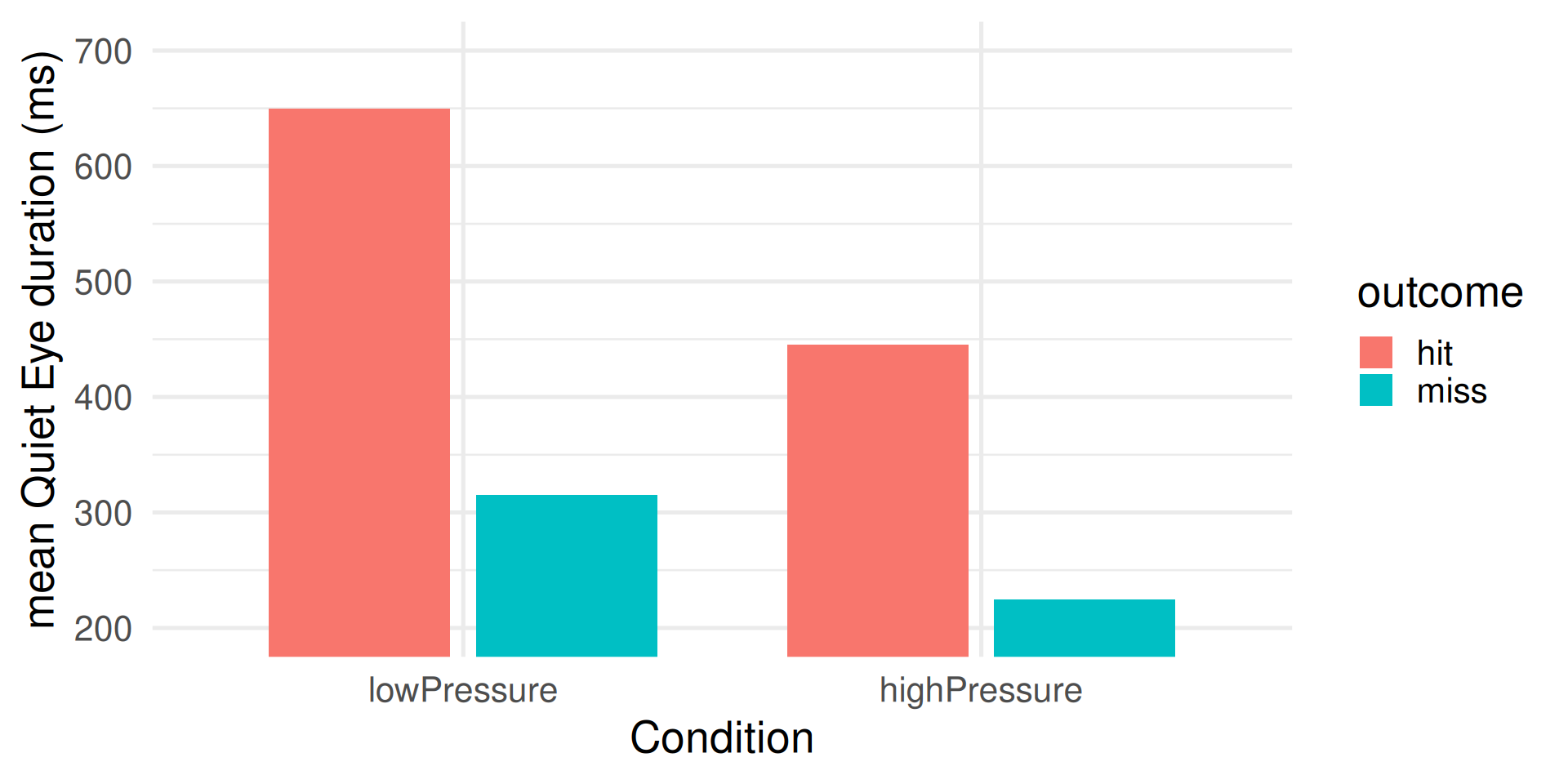
Effect of outcome: Shorter Quiet Eye duration for missed throws.
Effect of pressure: Shorter Quiet Eye duration under greater pressure.
Some evidence that attentional control is impaired under elevated state anxiety
Interventions
Attentional control can be improved through Gaze Training and Cognitive Training.
These interventions are not specific but compatible with Attentional Control Theory.
We will review what they are, what ACT-specific mechanisms they address (supposedly), and some empirical evidence supporting them.
Specificity of mechanisms
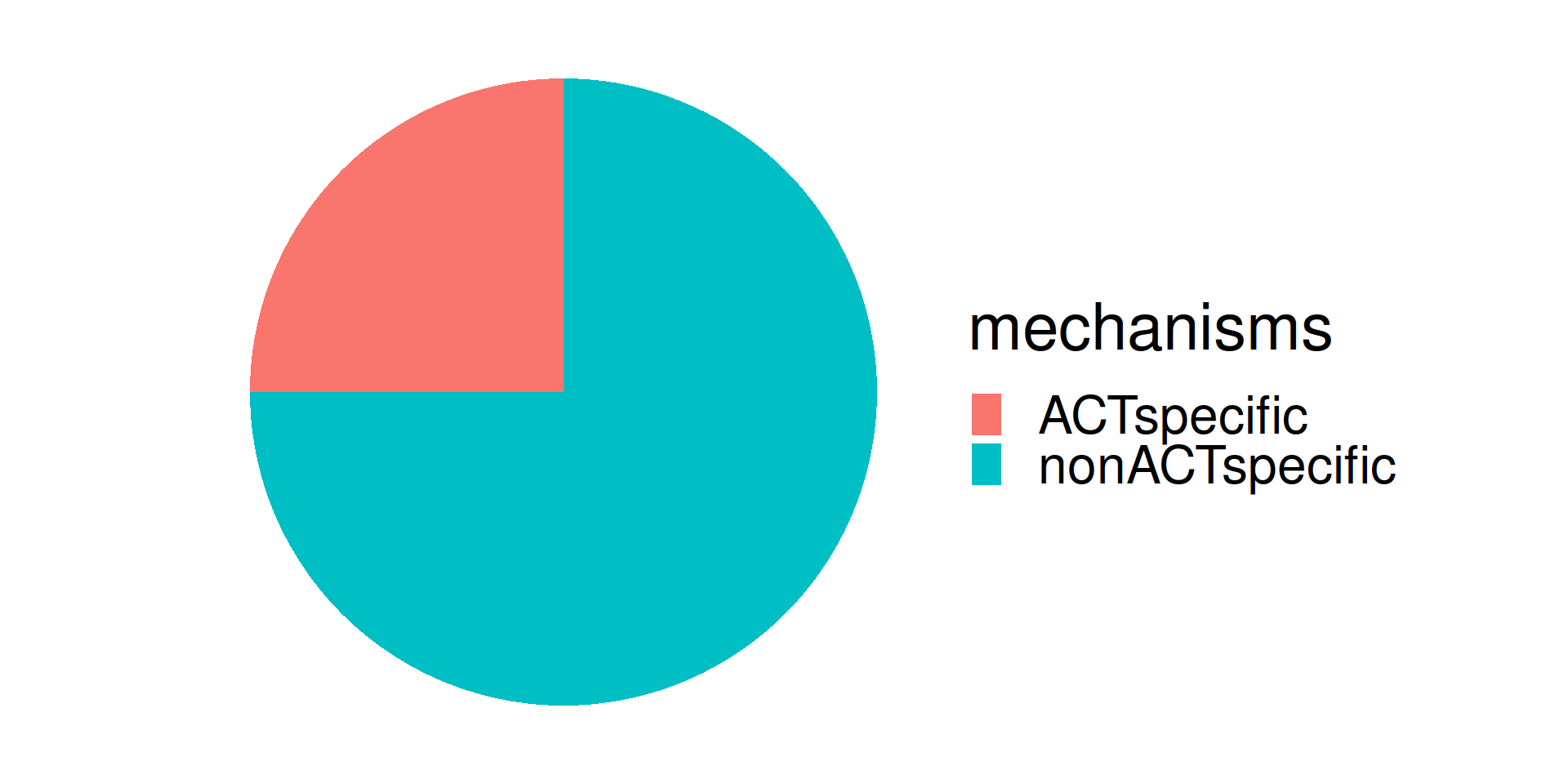
Several mechanisms have been proposed to explain why gaze trainign and cognitive training enhance performance under stress. Only some of those mechanisms are compatible with Attentional Control Theory. We will review only those.
Vine & Wilson (2010)
First Quiet Eye training study
Key methodology:
- N = 14 university students, minimal golf experience
- control goup: technical training
- experimental group: technical and Quiet Eye training
- Design: longitudinal (i.e., over time)
- Task: straight putts
Procedure:
Training protocol instructions
Technical instructions:
- Stand with legs hip width apart and keep your head still.
- Maintain relaxation of shoulders and arms.
- Keep the putter head square to the ball.
- Perform a pendulum-like swing and accelerate through the ball.
- Maintain a still head after contact.
Quiet Eye training instructions
- Assume stance and ensure that gaze is on the back of the ball.
- Fixate the hole. (Fixation should be made no more than three times.)
- Your final fixation should be on the back of the ball and for not longer than 2-3 seconds.
- No gaze should be directed to the club head or shaft during the putting action.
- Your fixation should remain steady for 200-300 ns after contact with the ball.
Key results:
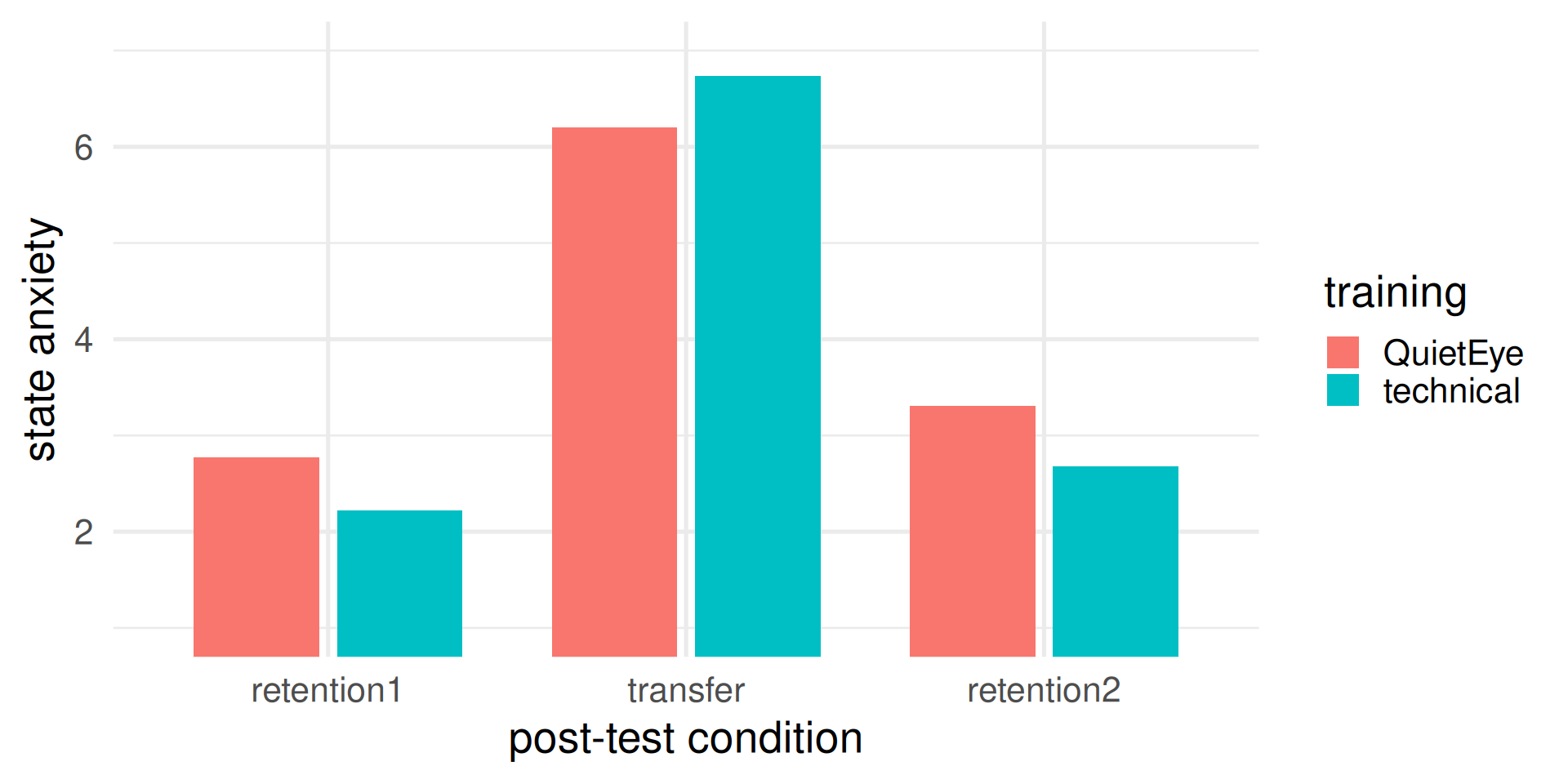
The training did not have an effect on state anxiety. The training did not distinguish people’s anxiety reaction to competitive pressure.
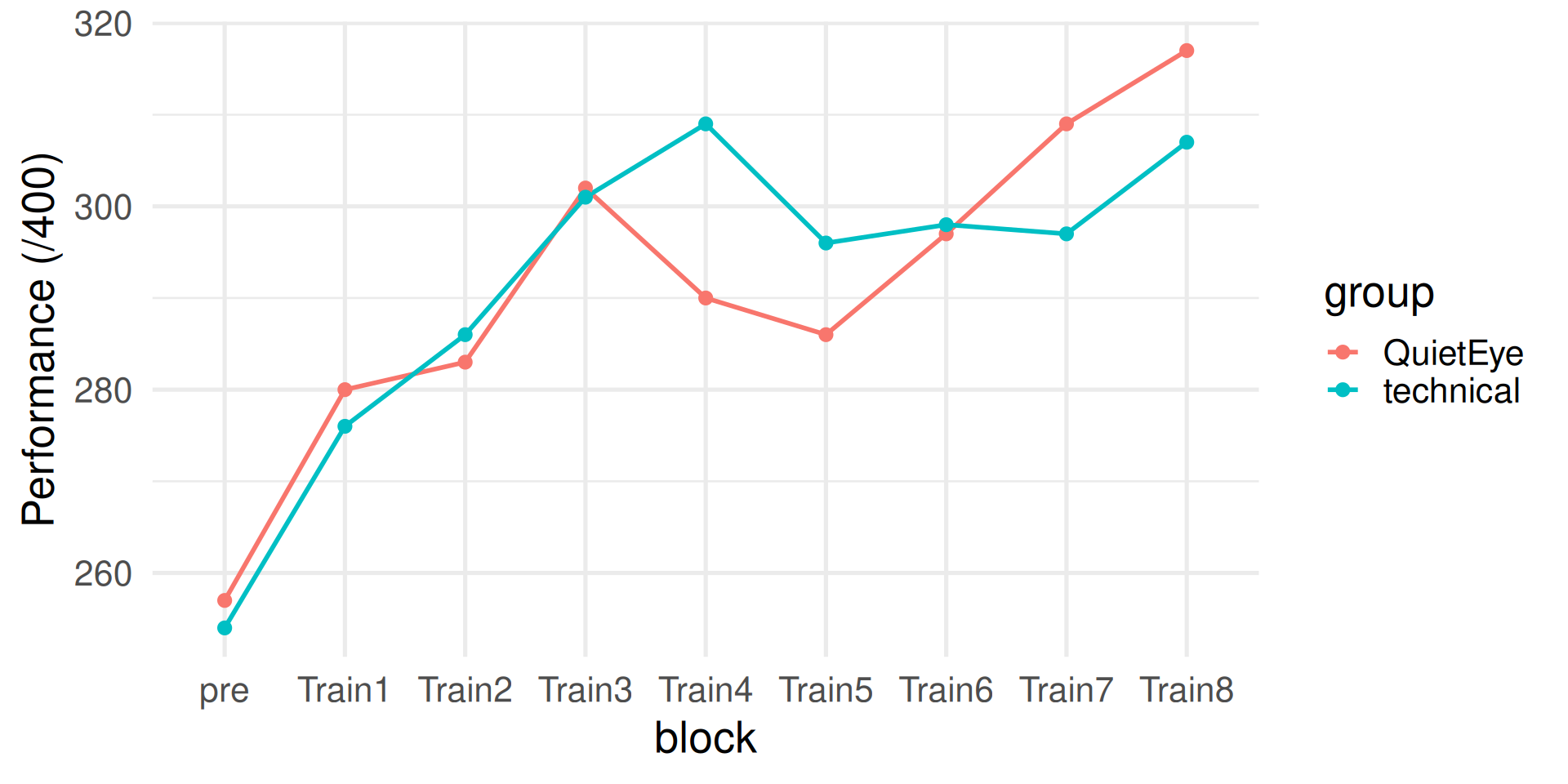
No performance differences at pre-test (before training).
Performance overall improving for both groups.
No obvious performance advantage on one group over the other.
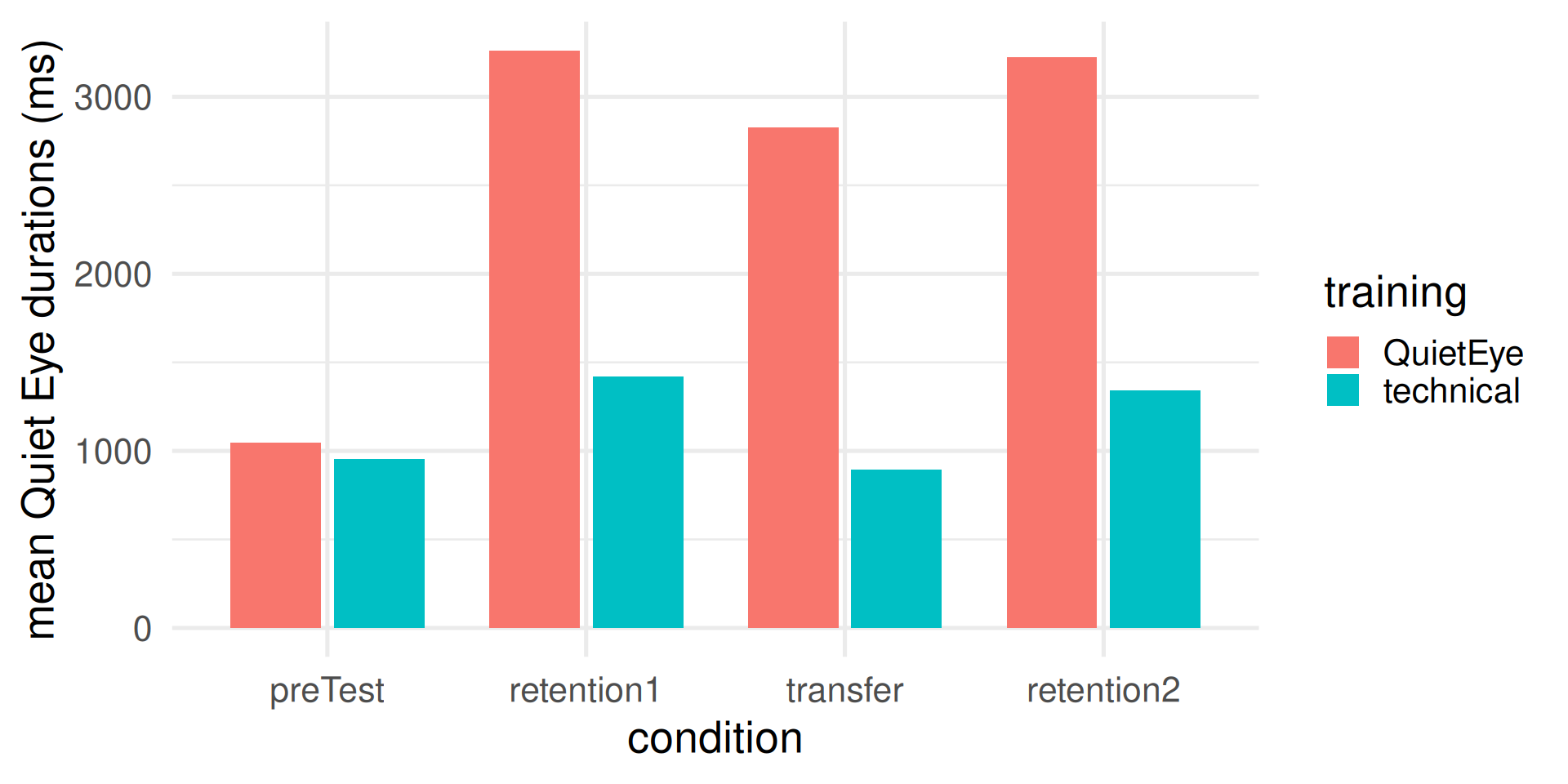
Quiet Eye durations were as expected:
- equal between groups at pre-test
- longer for the QE group, at the post-tests
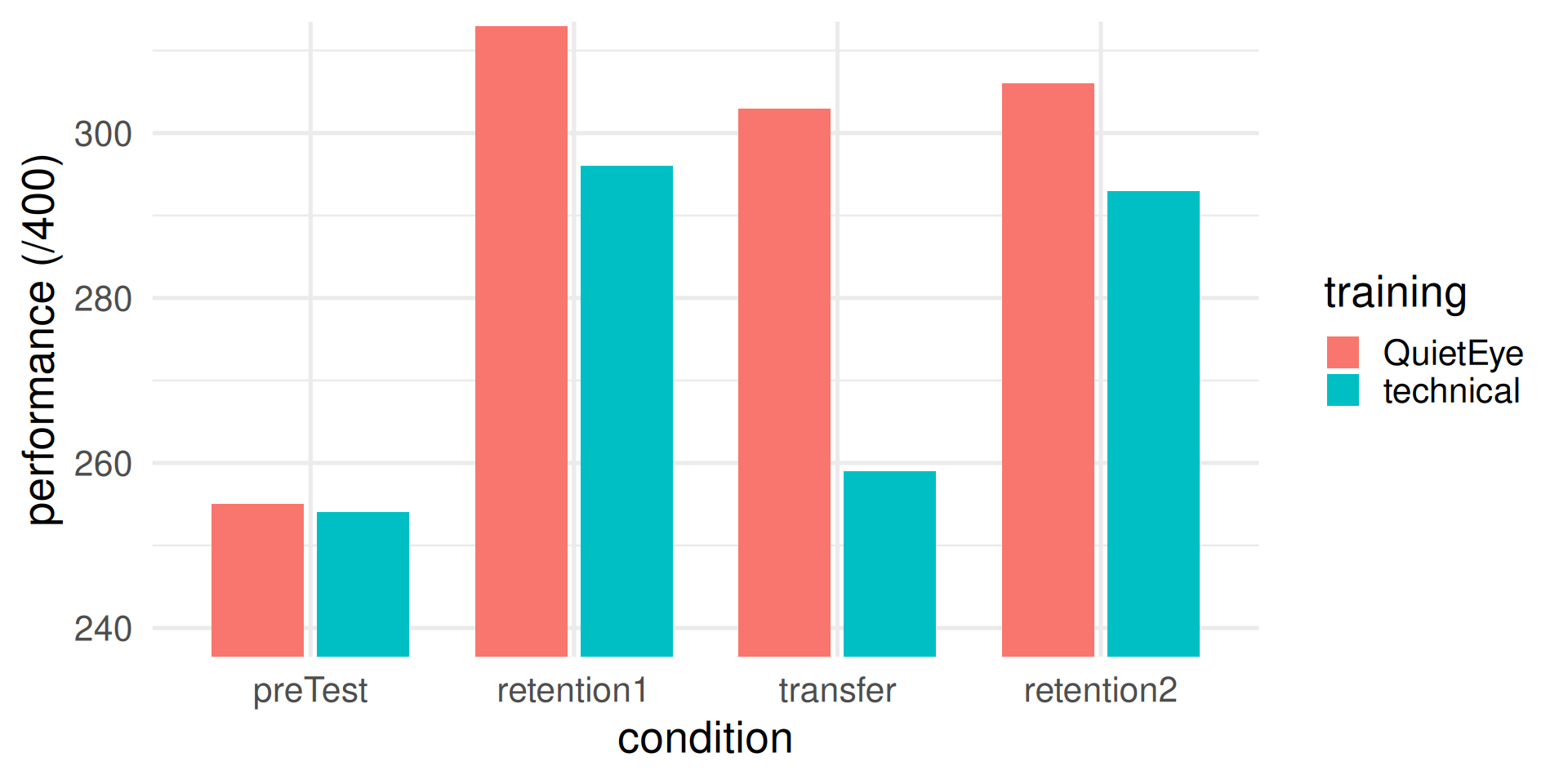
Performance was comparable across groups at all retention post-tests, except at transfer (high pressure performance), where the technical but not the Quiet Eye group showed a significant drop in performance
Optional: Some thoughts
Which model of performing under pressure is right?
Attentional control
Reinvestment
Challenge and threat appraisal
Psychomotor efficiency
Constrained action
Ironic processing
Etc.
No doubts these models will be refined again and again, and that’s the researcher’s job. For applied contexts, however, I encourage you to focus on the utility of a model (in explaining a phenomenon or achieving practical impact).
